After missing a deadline herself, Louise Dawtry, founder of What’s the Chari-tea? reflects on how the sector repeatedly confuses people’s capacity with their capability, and why that misunderstanding is driving burnout, disengagement and underperformance.
_____________________________________________________________________
Nothing humbles you faster than realising you simply cannot do the thing you said you’d do. I found myself unable to meet a deadline recently, and despite my 15 years as a People and Culture/HR professional, and building a community and podcast, ‘What’s the Chari-tea?’, to support other nonprofit people create healthier and more sustainable careers in the sector, I found myself feeling completely inadequate.
This feeling made me think about how often we can find ourselves in these situations and how much we mislabel ourselves and others as struggling or incapable. We’re confusing our capacity with our capability. And they are two very separate things.
Capacity is how much someone can hold.
Capability is what someone is able to do.
In purpose-led environments, it’s easy for us all to keep pushing past our capacity, often on a daily basis (hello burnout), and over time things not being done can look like a capability issue. I’ve seen this confusion happen time and time again and for years, I internalised this confusion myself. Whenever I couldn’t meet my own high expectations, I told myself I wasn’t good enough. And I see this pattern everywhere in the sector: people assuming they’re failing, when in reality they’re completely overwhelmed. Teams lose confidence, creativity dips and psychological safety erodes. Not because people lack capability, but because they’re operating far beyond their capacity.
This sector is full of brilliant, committed, passionate people, but it’s also full of pressures. High emotional load, blurred boundaries, and chronic understaffing mean many of us are already stretched before the day even begins. Add in a culture of “do more with less” and the guilt that comes with saying no, and it’s no surprise that we’re seeing a burnout rate of 78% (CharityJob 2026). And unfortunately this burnout often gets misread as underperformance.
I recently ran a session for a charity facing chronic under-performance and a management team that were unsure how to respond. Before we talked solutions, I asked their leadership team to pause and reflect on the following five questions to help them understand what was really going on in themselves, their teams, and their organisation as a whole:
1. What would you learn if you looked at someone’s workload before you judged their performance?
Pause and look at the volume, pace and emotional load they’re carrying. Is this a capability issue or simply too much for one person to manage?
2. When was the last time you asked your team if they felt at capacity?
Capacity conversations shouldn’t be rare or reactive. What would shift if checking in on bandwidth was normalised?
3. How do people in your organisation feel when they need to ask for help -supported, or exposed?
What signals, spoken or unspoken, might be teaching your team to stay silent?
4. If you compared the job description to the actual job, where’s the gap?
What would the role look like if it reflected reality rather than an aspiration?
5. What would change if you measured how people feel as seriously as you measure what they deliver?
Emotional sustainability in our work is the foundation of long-term capability. What organisational rhythms would help you and your teams stay well enough to do their best work?
Our sector doesn’t need more “capable” people, it needs better support. And when we get this distinction right, we build a sector where our brilliant people can stay, grow and do their best work, without losing themselves.
Next month I’ll be talking about purpose-led work and explaining more about the phrase I’ve coined, The Purpose Pinch.
Louise Dawtry is the founder of What’s the Chari-tea? a community and podcast that exists to help make the third sector a better place to work. The latest episode talks more about this subject and features guest, Stefanie Sword-Williams. You can connect with her on LinkedIn and Instagram @whatsthecharitea and learn more about her talks and events at www.whatsthecharitea.com


Latest News
-
Arts venue charity to close after ‘exhausting all possible alternatives’
-
Hospice charity repeatedly targeted by criminals launches appeal to improve security
-
Children’s charity refreshes brand to be clearer ‘about who it is’
-
Monday movers – 12 October 2026
-
Council terminates charity’s £8.57m children's care home contract early amid staffing concerns
-
Charity boss shows her 'vulnerability' as she posts emotional grant rejection video


Beyond the funding squeeze: Using equities to secure your charity’s future
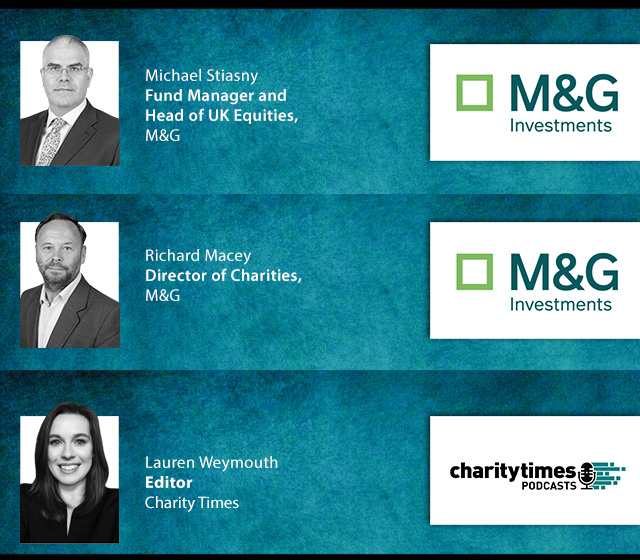
With charities facing increasing financial pressure and traditional income streams under strain, making investments work harder has never been more important. M&G’s Richard Macey and Michael Stiasny join Charity Times to discuss why equities remain a vital long-term asset class for charities, how organisations can balance income generation and growth, and the opportunities the current market environment may offer to help strengthen financial resilience.
Charity Times Awards 2023
Charity Times video Q&A: In conversation with Hilda Hayo, CEO of Dementia UK
Charity Times editor, Lauren Weymouth, is joined by Dementia UK CEO, Hilda Hayo to discuss why the charity receives such high workplace satisfaction results, what a positive working culture looks like and the importance of lived experience among staff. The pair talk about challenges facing the charity, the impact felt by the pandemic and how it's striving to overcome obstacles and continue to be a highly impactful organisation for anybody affected by dementia.




© 2021 Perspective Publishing Privacy & Cookies
Recent Stories