The Charity Commission suspended the chief executive of a disability charity revealing his employers knew of his offences as a convicted sex offender but refused to carry out a Criminal Records Bureau (CRB) check.
The Commission received a complaint jointly from two Councils relating to the Charity.
It was alleged that the charity trustees had knowingly employed a convicted sex offender and refused to carry out Criminal Records Bureau ('CRB') checks in the belief that such checks are an invasion of privacy despite having signed a contract with one of the Councils which stipulates that charity staff should be CRB checked.
The allegation related to the convicted sex offender 'A', who had been employed by the Charity as its Chief Executive Officer from January 2009 until 'A' was suspended in April 2009 by the Charity Commission and subsequently by the Charity.
It was also alleged that 'A' was awaiting trial for a similar offence allegedly occurred in 1987.
The Commission considered 'A' to be potentially unsuitable to hold the position within the Charity because of the fact and nature of 'A's' prior conviction, in addition to the current trial of 'A' for a related serious charge; the risk of harm to the nature of the Charity's purposes and activities; and the apparent absence of appropriate safeguards in place to protect the Charity's beneficiaries.
'A' was subsequently acquitted of the charge in early 2010.
'A' and the trustees made representations to the Commission stating that they did not consider 'A' to be an unsuitable person for the post and requesting that the Commission review its decision to issue the Order.
A Charity Commission 1 Decision Review panel upheld the decision to suspend 'A', concluding that the statutory grounds as detailed in the Statement of Reasons were met and that the decision to suspend was a reasonable and proper exercise of the Commission's powers, and proportionate in all the circumstances.
In April 2009, the Commission was notified that on the day it suspended 'A', the trustees had held an Extraordinary Meeting where a decision was taken to suspend 'A' on full pay.
This was as a result of the decision by one of the Councils to suspend the Charity's funding whilst 'A' remained a Charity employee.
However, the Commission was not advised of the trustees' decision until after it had made the Order to suspend 'A'.
Two trustees of the charity resigned soon after the Commission opened its Inquiry in April 2009.
In a letter to the charity trustees and copied to the Commission they stated that they had lost trust and respect in the officers of the charity and decided that their only course of action was to resign from the charity.


Latest News
-
Nine in ten charities using AI but few exploring its ‘true potential’, warns research
-
Evaluation reveals benefits of adding a virtual candle to online fundraising
-
Former Scope CEO to chair business group set up to tackle disability exclusion
-
Senior MP’s comparison of charity retail with vape shops criticised as 'outdated'
-
Working Families closes following ‘a sustained period of financial challenge’
-
Case study: How charities can best protect their storytellers





Charity Times video Q&A: In conversation with Hilda Hayo, CEO of Dementia UK
Charity Times editor, Lauren Weymouth, is joined by Dementia UK CEO, Hilda Hayo to discuss why the charity receives such high workplace satisfaction results, what a positive working culture looks like and the importance of lived experience among staff. The pair talk about challenges facing the charity, the impact felt by the pandemic and how it's striving to overcome obstacles and continue to be a highly impactful organisation for anybody affected by dementia.
Charity Times Awards 2023
Mitigating risk and reducing claims
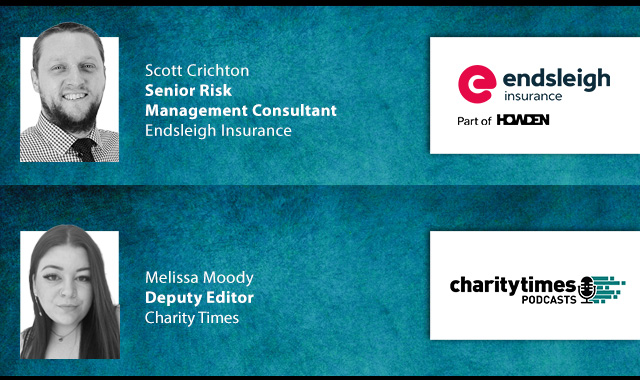
The cost-of-living crisis is impacting charities in a number of ways, including the risks they take. Endsleigh Insurance’s* senior risk management consultant Scott Crichton joins Charity Times to discuss the ramifications of prioritising certain types of risk over others, the financial implications risk can have if not managed properly, and tips for charities to help manage those risks.
* Coming soon… Howden, the new name for Endsleigh.
* Coming soon… Howden, the new name for Endsleigh.
Better Society





© 2021 Perspective Publishing Privacy & Cookies
Recent Stories