
Alison Dunn, CEO of the Society Matters Group and host of the This is the North podcast, argues that despite higher demand, charities in the North face the weakest funding base because giving continues to follow wealth, not need.
_________________________________________________________________________
In Sunderland, a foodbank volunteer told me she spends as much time turning people away as handing food out. The queues are long. The donations are short. That’s the brutal reality of charity in our country; those with the greatest need often live where there’s the least to give.
One mother captured this better than any statistic. Her son’s school was raising money for new books. She baked, she volunteered, she shook a collection bucket on the high street. But the money never came.
“How do you fundraise,” she asked me, “when no one around you has anything to give?”
That question cuts to the heart of the North–South divide in charitable giving. We like to imagine charities as a safety net; they’re there to catch those who slip through the cracks. But the truth is harsher. In the North of England, charities are being asked to make up for deep structural inequality, often with the weakest tools at their disposal.
The geography of giving
The numbers tell their own story. The South outpaces the North on almost every measure, including wealth, health, life expectancy, education and public investment. People give close to home, so generosity follows geography. The South East and City of London are awash with wealth and philanthropic convenience. However, while the will to give is just as strong in the North, many simply don’t have the means.
On the ground, the divide is painfully clear. The imbalance is written into the system. Between 2015 and 2019, a handful of streets in Notting Hill generated more in capital gains than the combined populations of Liverpool, Manchester and Newcastle. To bring that to life for you, that means fewer people than can fit into a football stand earned more than three great northern cities put together. When wealth is concentrated like that, so is giving.
Meanwhile, councils in wealthy southern boroughs with thriving commercial centres and unfathomable property prices can raise far more through council tax and business rates, whilst northern councils struggle with weaker local economies. Even Northern universities, highly acclaimed for their excellence and the engines of research and partnership for many charities, are caught in the divide. Not a single university north of Birmingham was included in the Government’s £53m Global Talent Fund. What message does that send to the people and businesses in the North?
Consequences in communities
For local charities, this isn’t just theory. It’s very real. It means closing doors when grants dry up. It means volunteers burning out, plugging holes with raffles, bake sales and crowdfunding. It means parents breaking down in advice centres like mine, Citizens Advice Gateshead, after being bounced between services designed more to deflect them than support them.
I remember a father in Gateshead who had waited for food parcels for a week. One evening, his son asked why they never went shopping like ‘normal families’. That father told me he carried those bags home in silence, ashamed not of himself but of a society that turned the power of his survival into a failure. And then, as I heard from the Lighthouse Project in Byker on an episode of my podcast This is the North, there are the children learning to mistake dignity for luxury. This reality should shame us all. On a visit to the project, one boy tugged his teacher’s sleeve, whispering “is this a five-star hotel?”. Unfortunately, he wasn’t joking. He was recognising something his community had never seen before: a place built to their potential, not their problems.
The way forward
To make progress in bridging the divide, three practical steps stand out.
Stability over roulette. Local charities need long-term funding, not the annual gamble of securing short-term grants that leaves them unable to plan for the future and constantly spinning the wheel of crisis management.
Redistribution where it matters. Charity, at its heart, is redistribution. That means directing money from where it is plentiful to where it is needed most. National campaigns and philanthropic funds must be structured to flow northwards, not simply reward areas with pockets deep enough to support themselves. Shifting power. Seven in every ten of the UK’s largest charities are headquartered in London or the South East. If broadcasters like the BBC and Channel 4 can relocate, why can’t charities? Why not industry? Why not government? Real decisions, real jobs, and real budgets need to be moved north. Token outposts are not enough.
Time for change
I’m not trying to generate pity for the North. Ultimately though, I want fairness for the country. Without systemic change, charity will continue to be governed by geography and not need. Mothers will keep shaking empty collection buckets. Fathers will keep carrying food parcels home in silence. Children will keep mistaking dignity for luxury not because the North doesn’t care, but because the structures are stacked against it.
Unless we embrace redistribution, stable investment and decentralisation, we risk entrenching inequality for the future instead of challenging it.


Latest News
-
Arts venue charity to close after ‘exhausting all possible alternatives’
-
Hospice charity repeatedly targeted by criminals launches appeal to improve security
-
Children’s charity refreshes brand to be clearer ‘about who it is’
-
Monday movers – 12 October 2026
-
Council terminates charity’s £8.57m children's care home contract early amid staffing concerns
-
Charity boss shows her 'vulnerability' as she posts emotional grant rejection video


Beyond the funding squeeze: Using equities to secure your charity’s future
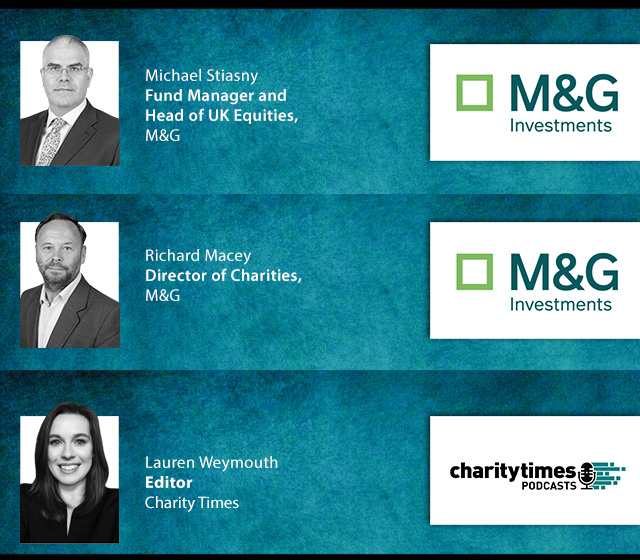
With charities facing increasing financial pressure and traditional income streams under strain, making investments work harder has never been more important. M&G’s Richard Macey and Michael Stiasny join Charity Times to discuss why equities remain a vital long-term asset class for charities, how organisations can balance income generation and growth, and the opportunities the current market environment may offer to help strengthen financial resilience.
Charity Times Awards 2023
Charity Times video Q&A: In conversation with Hilda Hayo, CEO of Dementia UK
Charity Times editor, Lauren Weymouth, is joined by Dementia UK CEO, Hilda Hayo to discuss why the charity receives such high workplace satisfaction results, what a positive working culture looks like and the importance of lived experience among staff. The pair talk about challenges facing the charity, the impact felt by the pandemic and how it's striving to overcome obstacles and continue to be a highly impactful organisation for anybody affected by dementia.




© 2021 Perspective Publishing Privacy & Cookies
Recent Stories