
In a new series, readers ask our new columnist, Nicola Barber, a series of questions relating to investment and trusteeship.
Nicola has over 35 years of investment experience, including working as an independent trustee for a UK family trust and a trustee director for the pension scheme of the Citizens Advice Bureau. She joined James Hambro & Partners in early 2012 and is an experienced equity investor and portfolio manager specialising in managing portfolios for larger and more complex clients. Nicola chairs the firm’s Corporate Social Responsibility (CSR) and Responsible Investment Committees which are integral to the firm’s culture and management of client portfolios respectively. She supports charities through dedicated trustee training and writes and presents widely. Nicola is an active member of the CFA Institute.
-------------------------------------------------------------------------------------------------------------
Question: Should we have more than one person with investment experience on our board? We are currently reviewing our policy and they are the only person who can contribute confidently, making it quite difficult to make the decisions as a team.
Answer: There is no perfect answer to this question as every board is unique in terms of the contribution of skills and resources they bring.
There are, however, some guiding principles that promote robust governance in order that trustees can deliver on their purposes, work effectively both as individuals and as a team and exercise effective control. To clarify, trustees can choose an investment approach that they believe is in the best interests of the charity provided they further the charity’s purposes.
Trustees should follow their intuition and flag issues that are less familiar to establish a ‘roadmap’ and ensure everyone, or maybe a sub-committee, is brought along on the same journey. Having more than one investment expert on the board can often be beneficial and I am wondering if there is any additional expertise within the wider organisation?
Investments should be reviewed regularly, and whilst it is one thing to delegate responsibility to an investment firm, it is quite another to set the mandate with confidence as a series of important decisions may influence a wide range of outcomes. Key areas to consider include suitability, diversification, the duty to take advice and approaches that may lawfully be considered when avoiding certain investments.
Having a wider base of knowledge and inputs from across the board in this important area is helpful and will allow trustees to fulfil their fiduciary duties and meet their strategic plans. It is quite a responsibility, so sharing the decision making and working with agreed objectives is optimal.
There are several resources that can bridge the knowledge gap and develop a suitable Investment Policy. I have split these into two broad areas. The first list outlines what good investment practice looks like and can be found on the respective websites, and the second list brings the theory into practice. Neither are exhaustive.
The first list includes the Charity Commission guidance which was updated on 1 August 2023 (CC14), CAF, NCVO and CFG. The second list involves asking your investment manager to provide investment training, receiving quarterly valuation reports and investment commentary, attending charity conferences and potentially seeking the services of an external consultant.
Finally, I would suggest that a governance review more generally may be helpful to highlight any deficits in knowledge which will allow the opportunity to receive additional training and ultimately protect your charity’s reputation and values for years to come.
This article should not be construed or relied on as advice.
Nicola Barber is a Partner and Head of Charities at James Hambro & Partners LLP which is authorised and regulated by the Financial Conduct Authority and is a registered investment adviser of the Securities and Exchange Commission. It is listed in the Financial Services Register with reference number 513246.





Beyond the funding squeeze: Using equities to secure your charity’s future
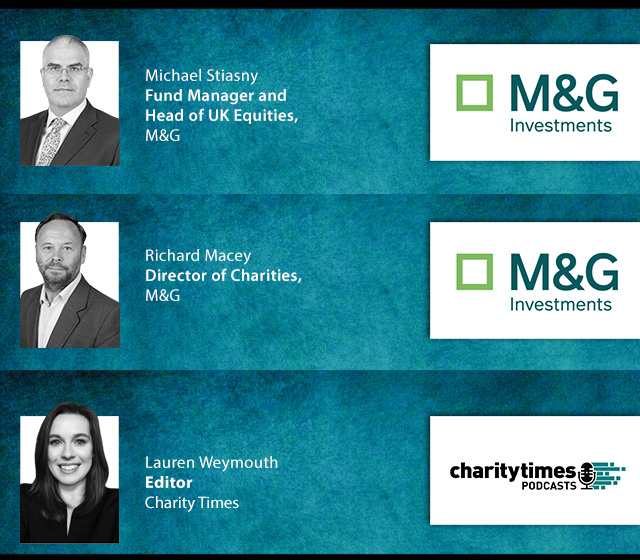
With charities facing increasing financial pressure and traditional income streams under strain, making investments work harder has never been more important. M&G’s Richard Macey and Michael Stiasny join Charity Times to discuss why equities remain a vital long-term asset class for charities, how organisations can balance income generation and growth, and the opportunities the current market environment may offer to help strengthen financial resilience.
Charity Times Awards 2023
Charity Times video Q&A: In conversation with Hilda Hayo, CEO of Dementia UK
Charity Times editor, Lauren Weymouth, is joined by Dementia UK CEO, Hilda Hayo to discuss why the charity receives such high workplace satisfaction results, what a positive working culture looks like and the importance of lived experience among staff. The pair talk about challenges facing the charity, the impact felt by the pandemic and how it's striving to overcome obstacles and continue to be a highly impactful organisation for anybody affected by dementia.




© 2021 Perspective Publishing Privacy & Cookies
Recent Stories