
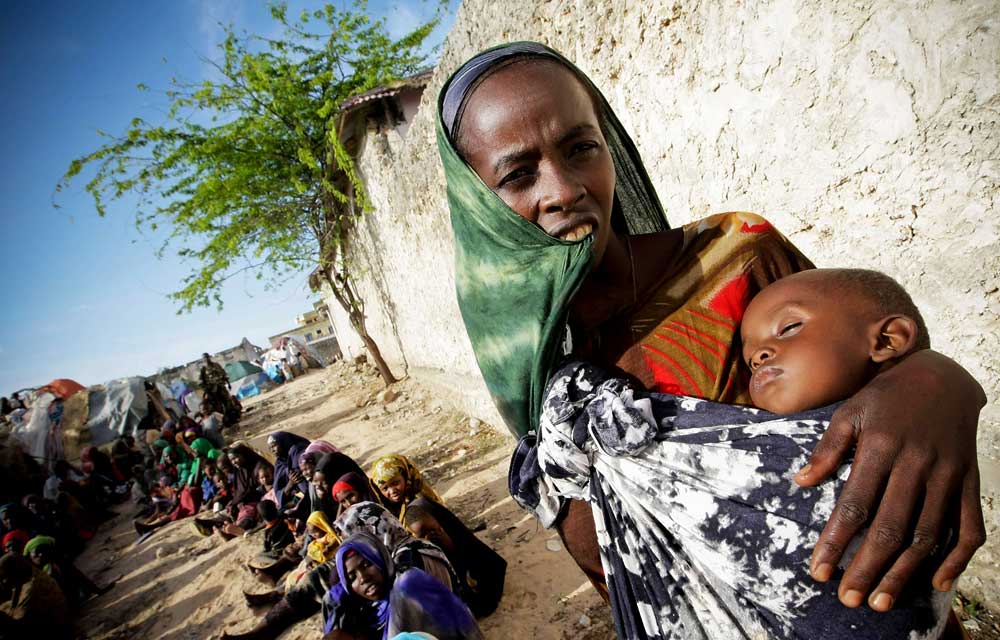
'Pitiful’ imagery that depicts people from across the world suffering from illness and hardship are being used less frequently by charities in their advertising campaigning, research has found.
While analysis from 2011 to 2014 found just over a third of British advertising contained such imagery, by 2021 this had dropped to just over one in ten.
The research has been carried out by the University of East Anglia, which highlights how images of suffering and poverty used by international aid organisations “unwittingly reproduced colonial stereotypes” and reflect “inequalities” between countries.
It points out that such imagery of appeals to support communities in Africa “reiterates the colonial trope of blackness and poverty”.
“This continuous majority casting of African nations in the theatre of global development as recipients of humanitarian assistance, serves only to aid and abet the colonial notion of Africa as one huge ‘begging bowl’.”
“We are pleased that this project has provided evidence indicating an improvement in the representation of distant others” in charity fundraising advertising, says their report.
“On the whole, there is a marked difference in the organisation of cast and characters present in charity’s communications imagery and pitiful images are nearly entirely absent, while individuals are presented more as named than unnamed.”
'Overuse of villages'
However, concerns remain over the use of locations and people within imagery.
Researchers found that the “majority of photographs” have a similar theme.
“They are usually of children, or women and children, and depict rural areas and poverty. As a result, whole areas and regions of the world can become reduced to poor women and children living in unnamed rural places”, researchers found.
There is “a notable disparity between the settings of images showing female subjects as opposed to male”.
The rural settings “paint a picture of an Africa frozen in time, furthering the colonial notion of ‘Africa’ as one big village”, researchers add.
“The overuse of villages in charity communication to the exclusion of urban settings, constructs an Africa that continues to be backward and underdeveloped.”
‘White saviour’
A study by Blue State in 2021 found that young people were among those most likely to be put off by white saviour imagery in international aid charities’ fundraising promotion.
Instead, they called for more positive imagery of work that charities are funding abroad.
Two in five 25–34-year-olds selected positive images to donate to, compared to only around a quarter of those aged over 55.


Latest News
-
Scope apologies after axing choir’s performance over founder’s gender-critical views
-
Major funder ‘aware of the risks’ as it tests using AI to assess applications
-
Charities share £450,000 in funding from housing partnership
-
CEO of social entrepreneurs' funder to step down after 11 years
-
Friday funding round up – 23 October
-
Hospice charity consults staff on restructure plans amid £1.8m deficit

.jpg)
Video Q&A: In conversation with Vicki Sellick MBE, CEO of Good Things Foundation
Vicki Sellick MBE, CEO of Good Things Foundation joins Charity Times editor, Lauren Weymouth to discuss her leadership journey, the organisation’s new strategy and the findings of the Digital Nation 2026 report. She explores the challenges of digital inclusion, the opportunities and risks of AI, and how the sector can ensure nobody is left behind.
Video Q&A: Benefits of bespoke investment vs pooled funds for the third sector
In this Charity Times video Q&A, editor Lauren Weymouth speaks to Ed Caswell of RBC Brewin Dolphin to explore how charities can align investment strategies with their mission, balance income and growth, and adapt to changing needs. He discusses discretionary management, responsible investment and the importance of effective governance and regular portfolio reviews.
Charity Times Awards 2023


© 2021 Perspective Publishing Privacy & Cookies
Recent Stories