The former Charity Finance Group CEO argues that love, empathy and shared leadership are not soft ideals but hard strategies for survival, and that the sector’s next chapter depends on them.
_________________________________________________________________
As the long-serving chief executive of Charity Finance Group (CFG), Caron Bradshaw has become one of the sector’s most influential voices on leadership, finance, equality and organisational culture. Now, as she moves into a new role, heading up innovation and development at CFG – and hands the reins to a new co-leadership team – she’s taking stock of what she’s learned from a career spent championing charities and the people within them.
Bradshaw’s commitment to social good began long before job titles and boardrooms. “My parents used to joke about the fact that I used to rush down the little lane that we lived in and go and do the shopping for the little old ladies and men,” she recalls. “I think my first quasi-trusteeship, I was about 16 and sat on the management committee of our local charitable theatre group.”
But she didn’t move into the charity sector straight after leaving school; instead, she initially pursued a career in law. Training as a barrister shaped her early approach to governance, she says. “It gave me the ability to very rapidly consume a lot of detailed information and pull out the nub,” she says. “The barrister training was very good at the diplomacy you need in governance situations, the ability to see something from someone else’s perspective and find a way through without it being overly emotional.”
But Bradshaw explains that it wasn’t her qualifications that shaped her leadership – it was a personal crisis that profoundly transformed her as a leader.
Breaking down to break through
In 2013–14, Bradshaw experienced a mental health breakdown. “I completely rolled off my perch”, she recalls. “I had a complete breakdown. I didn’t think I’d ever come back from it.”
But she did, and in the process it completely changed the way she thought about leadership. In 2015, she was named Charity Times’ ‘Charity Leader of the Year’.
“That was the thing that changed the whole of my approach to leadership completely,” she says. “It really pushed me down the route of thinking about how you see the humanity of people… give people dignity and purpose and support them as they identify who they are and how they want to show up in the world.”
Today, she speaks openly about mental health and burnout in leadership, not as a weakness, but as an inflection point for growth. She returned to work stronger, more empathetic, and more determined. “My breakdown was my breakthrough,” she adds. “I wouldn’t give up that experience for all the money in the world because it profoundly shapes me as a person.”
She’s open about the fact her experiences shaped the way she led, and decisions she made. Much of Bradshaw’s tenure at CFG was marked by bold decisions, including the recent shift to a co-leadership model. Rather than appointing a single successor, CFG now has two CEOs: Clare Mills and Sarah Lomax.
“When we came to succession planning… there’s a lot of merit in not having a sole voice,” Bradshaw explains. “You’re not going to be equally good at all aspects of the job. So having two heads… felt like a real opportunity to challenge the status quo.”
For Bradshaw, this shift isn’t just organisational housekeeping; it’s a statement of intent about how power can and should be shared in the charity sector. She highlights the resilience benefits of shared leadership: “If both people want the CEO role and only one gets it, you risk losing the other. This model allows us to evolve… to build continuity while still moving forward.”
It’s also a model that reflects CFG’s values and offers continuity, resilience, and mentorship. And Bradshaw isn’t one to hand over the reins and never be heard of again – she remains at CFG involved in a part-time role focused on innovation, partnership and development.
Her new role is what she affectionately describes as ‘a sales role with bells on’. “My dad used to say: ‘I don’t sell anything; I believe in the product.’ That’s how I feel about CFG. I believe in what the organisation does and in the people who make it work.”
Leading through adversity
Bradshaw’s belief in CFG was no more evident than during the Covid-19 pandemic. For her, it was a defining moment; one that revealed the best of the sector’s collective spirit. CFG played a pivotal role in bringing organisations together, influencing government support, and helping the sector navigate unprecedented financial shocks.
“We were providing an awful lot of insight and connectivity with members on the sharp end that enabled us to really, as a sector, influence government in a way that had never been done before.”
Despite the crisis, Bradshaw found the period energising. “There was a real sense of, yes, we do need to collaborate… to centre the interests not of organisations, but of the beneficiaries.”
Bradshaw has also been a vocal advocate for equity, diversity, and inclusion (EDI) across the sector. Her philosophy is clear: “The biggest shift is the language that has shifted from trying to help people fit in the system to trying to help people fix the system.”
She believes the sector must challenge broken structures rather than adapt to them. “If all we ever do is try and help [minoritised groups] fit in with a system that’s broken and doesn’t serve us, then we’re not actually serving anyone.”
She acknowledges that this kind of work isn’t easy, especially in a sector often under-funded and overstretched. But she insists that avoiding it is a false economy. “If we don’t put the resources aside to make the system better, we’ll never solve the problems we’re here to change.”
This approach requires courage and disruption. “We have to talk to funders about their practices. We have to talk to our partners about how they lead…whether they’re trying to save and rescue others or create platforms for those voices to be heard.”
Her critique extends beyond charities to the national stage. She worries about the current political climate, where division and fear dominate public discourse.
“Most people aren’t hateful, they’re scared. The answer isn’t more hate; it’s love, understanding and empowerment. History will look back on this time and ask: did we do enough? I hope we can say yes.”
Facing challenges head-on
Bradshaw doesn’t shy away from the challenges facing the charity sector. Financial pressures are top of mind. “Donations from the public have remained largely flat. Contracts from government have reduced. Earned income is getting harder to generate. Retail is facing increasing costs.”
“We’re in a perfect storm,” she summarises. She worries about the impact on beneficiaries. “The sector will survive. Whether the people we support do is an entirely different question.”
She lists other mounting challenges: the climate crisis, the disruptive power (and potential) of AI, and an increasingly divided political landscape. “We don’t have the luxury of time or resources. We have to change the tyres while we drive the car.”
But as ever, she sees opportunity in adversity.
“Every risk has an opportunity sitting alongside it. Maybe charities can be the beacon of hope, the connectors of purpose and community at a time when people are crying out for both.”
This is no more evident than in emerging technologies. “It’s difficult not to be excited by what AI can do,” she says. “It’s been really helpful to increase the pace with which I can think and develop content.”
What’s next
Bradshaw’s new role at CFG allows her to focus on long-standing projects that lacked capacity. “Me being around to do it gives a little bit of capacity to kind of get those things out of the blocks.”
Outside of CFG, she’s building a portfolio career. She recently became chair of the press regulator Impress and is exploring a women’s leadership retreat. “It’s a gem of an idea at the moment,” she says. “I’m hoping to do some coaching and sharing of that leadership experience.”
She’s also writing a book on ‘loving leadership’ – a concept that underpins her entire career. “I had to pause it to write the one for the DSC on finance,” she laughs. “But hopefully I can get back to it now.”
In her spare time, she’s a hands-on creative: she paints, upholsters, and plays hockey. “I’m very practical,” she admits. “I like making things.”
For all her accolades – OBE, awards, and sector influence – Bradshaw’s legacy isn’t built on status. It’s built on authenticity, on having the courage to talk about failure as much as success, and on a belief that leadership rooted in love is not a soft option but a radical one.
“If we can lead with love, with understanding, empathy, and a belief in people’s potential — that’s when we make real change.” It’s a deceptively simple idea, but for a sector built on care, it may just be the most radical one of all

Latest News
-
Russell Howard and his wife launch charity after the loss of their baby
-
Government reveals delivery partner for £11.6m fund to improve charity and council links
-
Major grant makers name first recipients of £15m fund to tackle child poverty
-
Friday funding round up – 4 September
-
Minister promises action against those misusing the law to threaten charities
-
CEO of pay dispute hit museums charity to step down


Beyond the funding squeeze: Using equities to secure your charity’s future
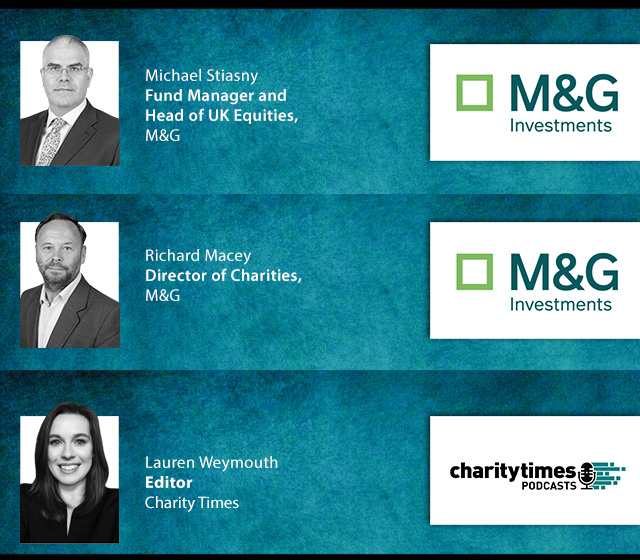
With charities facing increasing financial pressure and traditional income streams under strain, making investments work harder has never been more important. M&G’s Richard Macey and Michael Stiasny join Charity Times to discuss why equities remain a vital long-term asset class for charities, how organisations can balance income generation and growth, and the opportunities the current market environment may offer to help strengthen financial resilience.
Charity Times Awards 2023
Charity Times video Q&A: In conversation with Hilda Hayo, CEO of Dementia UK
Charity Times editor, Lauren Weymouth, is joined by Dementia UK CEO, Hilda Hayo to discuss why the charity receives such high workplace satisfaction results, what a positive working culture looks like and the importance of lived experience among staff. The pair talk about challenges facing the charity, the impact felt by the pandemic and how it's striving to overcome obstacles and continue to be a highly impactful organisation for anybody affected by dementia.




© 2021 Perspective Publishing Privacy & Cookies
Recent Stories