New research published today reveals that employees in the Third Sector have among the highest levels of trust in their senior management teams.
Research by the Institute of Leadership & Management (ILM) and Management Today shows that charity sector CEOs are among the most trusted, achieving an Index score of 63 [against an average CEO Index score of 59 and the overall scale of 0-100], when assessed by the general population of employees, which rises to an impressive 72 when assessed by managers in the sector.
Line managers in Third Sector organisations are also considered highly trustworthy, with an index score of 72.
The research revealed that length of tenure is a vital component of trust. The longer CEOs and line managers have been in post the more trust employees have in them.
Trust takes time to earn, and the research indicates that this is unlikely to be achieved in less than five years.
This is clearly demonstrated in the Third Sector, where length of service for CEOs is generally longer than average. 37% of charity and voluntary sector employees said that their CEO had been in post for more than five years, compared with only 23% in national/local government and 24% in the financial sector.
While CEOs of large organisations amassed a low Trust Index score, managers of smaller organisations - as observed in the Third Sector - engender the highest levels of trust in their staff. 61% of charity and voluntary employees surveyed came from companies with staff of 250 people or less.
The high levels of trust in the Third Sector may also be down to gender balance. 70% of the respondents in the charity sector were women.
The main survey found that women have higher levels of trust in their managers than men when they start a job, but this falls sharply the longer they stay in the same position, raising serious questions about the quality of women's experience in the workplace.
The high levels of trust among women in the third sector seems to be the direct result of senior management remaining more constant.
The Index identifies and measures the six factors that are fundamental to trust - ability, understanding, fairness, openness, integrity and consistency - identifying a clear roadmap for individuals to build trust in themselves and their organisations.
The research reveals that the two most important factors for CEOs are ability and integrity. In contrast, though line managers are more trusted, employees expect a more diverse range of qualities and characteristics from them.
As well as ability (top of the list) and integrity, line managers are required to demonstrate understanding, fairness and consistency.
ILM's Chief Executive, Penny de Valk, said: "Trust is crucial to the performance of an organisation, and a cornerstone of good leadership. Teams are more effective in a trusting environment, and people work better and harder if they trust their leaders.
"But for leaders, being good at their job is simply not enough anymore. They have to be aware of their 'signal value' and how this is perceived by employees as a sign of integrity. The more senior you are, the more the gap between what you say and what you do - or what you don't say or do - is amplified. In recessionary times, employees are anxious and this spotlight will be yet further intensified."
The ILM and Management Today polled 5,673 people - 2,938 managers and 2,735 non-managers - for the Index of leadership Trust.
They came from the private, public and charity sectors, and their organisations ranged in size from SMEs to global corporations.
The survey asked how much they trusted their line managers and their CEOs, presenting a snapshot of trust from within an organisation. In total 213 charity and voluntary sector employees responded to the survey.
The full report, ILM/MT Index of Leadership Trust 2009, is available to download from ILM's website: www.i-l-m.com.


Latest News
-
Evaluation reveals benefits of adding a virtual candle to online fundraising
-
Former Scope CEO to chair business group set up to tackle disability exclusion
-
Senior MP’s comparison of charity retail with vape shops criticised as 'outdated'
-
Working Families closes following ‘a sustained period of financial challenge’
-
Case study: How charities can best protect their storytellers
-
British Heart Foundation to close almost one in four of its charity shops





Charity Times video Q&A: In conversation with Hilda Hayo, CEO of Dementia UK
Charity Times editor, Lauren Weymouth, is joined by Dementia UK CEO, Hilda Hayo to discuss why the charity receives such high workplace satisfaction results, what a positive working culture looks like and the importance of lived experience among staff. The pair talk about challenges facing the charity, the impact felt by the pandemic and how it's striving to overcome obstacles and continue to be a highly impactful organisation for anybody affected by dementia.
Charity Times Awards 2023
Mitigating risk and reducing claims
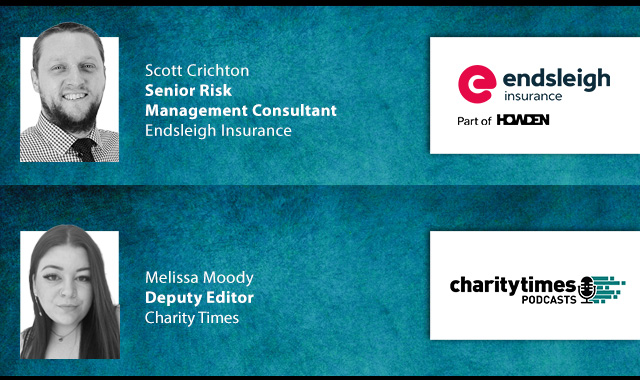
The cost-of-living crisis is impacting charities in a number of ways, including the risks they take. Endsleigh Insurance’s* senior risk management consultant Scott Crichton joins Charity Times to discuss the ramifications of prioritising certain types of risk over others, the financial implications risk can have if not managed properly, and tips for charities to help manage those risks.
* Coming soon… Howden, the new name for Endsleigh.
* Coming soon… Howden, the new name for Endsleigh.
Better Society




© 2021 Perspective Publishing Privacy & Cookies
Recent Stories