As the economic downturn has worn on, the Scottish public has increasingly felt that charitable donations made north of the border should also be spent there, according to new data out today.
Scottish males, those from higher social-demographic groups, 25-34-year olds and non-donors have especially driven this more philanthropically insular trend.
These are the latest key findings from not-for-profit sector research consultancy nfpSynergy's Scottish Charity Engagement Monitor, yielding regular insights into what the Scottish public thinks about a range of charitable and social issues.
Overall, the proportion of Scots claiming they would prefer any charitable donation they made to be spent in Scotland rose from under half (48%) back in April 2007, pre-downturn, to almost 3 in 5 (59%) in Oct 2009.
Groups showing the sharpest rise in propensity for Scottish donations to benefit the Scots have been men (48% April 2007, 60% Oct 2009); social grade ABs (39% April 2007, 52% Oct 2009) and C1s (44% April 2007, 59% Oct 2009), although C2s and DEs are still more likely to want Scottish charity kept "at home"; 25-34-year olds (48% April 2007, 66% Oct 2009); and non-donors (51% April 2007, 64% Oct 2009).
nfpSynergy's researcher, Jonathan Baker, commented: "As the downturn has worn on, and corresponding social need has doubtless increased, the Scottish public has felt ever more strongly that charity begins 'at home'. This will have come at the expense of money they would previously have preferred spent elsewhere in the UK, or wider internationally.
"Scottish charities should thus emphasise their local spending on local beneficiaries if they wish to boost domestic donations from the Scottish public. Moreover, a brand which clearly communicates Scottish identity will help a charity better achieve this.
"Naturally, it may well be that Scots choose to override this broadly insular charitable trend when confronted by such an exceptional major overseas disaster as the recent earthquake in Haiti
The survey covers a representative sample of over 1000 adult Scots, online twice-yearly.


Latest News
-
Nine in ten charities using AI but few exploring its ‘true potential’, warns research
-
Evaluation reveals benefits of adding a virtual candle to online fundraising
-
Former Scope CEO to chair business group set up to tackle disability exclusion
-
Senior MP’s comparison of charity retail with vape shops criticised as 'outdated'
-
Working Families closes following ‘a sustained period of financial challenge’
-
Case study: How charities can best protect their storytellers





Charity Times video Q&A: In conversation with Hilda Hayo, CEO of Dementia UK
Charity Times editor, Lauren Weymouth, is joined by Dementia UK CEO, Hilda Hayo to discuss why the charity receives such high workplace satisfaction results, what a positive working culture looks like and the importance of lived experience among staff. The pair talk about challenges facing the charity, the impact felt by the pandemic and how it's striving to overcome obstacles and continue to be a highly impactful organisation for anybody affected by dementia.
Charity Times Awards 2023
Mitigating risk and reducing claims
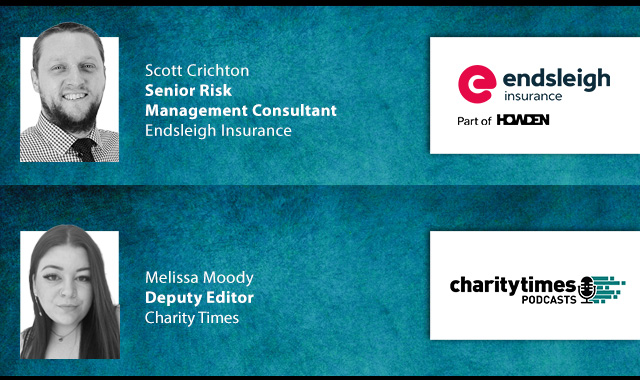
The cost-of-living crisis is impacting charities in a number of ways, including the risks they take. Endsleigh Insurance’s* senior risk management consultant Scott Crichton joins Charity Times to discuss the ramifications of prioritising certain types of risk over others, the financial implications risk can have if not managed properly, and tips for charities to help manage those risks.
* Coming soon… Howden, the new name for Endsleigh.
* Coming soon… Howden, the new name for Endsleigh.
Better Society




© 2021 Perspective Publishing Privacy & Cookies
Recent Stories