First of all, some definitions are required: an early "caveat emptor" warning: while there should be an obvious and clear distinction between a "pooled" (using funds to implement investment policy) as opposed to "segregated" (owning positions in individual stocks, shares and bonds) investment, the water has been muddied in the charity world.
Specifically, many charity investment managers offer what they call a "segregated" service when what they really mean is a "semi-segregated" service. This would typically involve investing directly in government bonds and UK equities and in a selection of unit
and investment trusts where allocations are made to overseas equities, corporate bonds, property and other peripheral asset classes like hedge funds and private equity.
This used to mean that the bulk of charity portfolios were invested predominantly in a segregated manner. However, given the reduction in exposure to UK equities (WM would suggest 62% in 1999 compared to just 42% today) and the increase in exposure to overseas equities, corporate bonds and other "newer" asset classes, there has been
a significant increase in the proportion that is invested in funds.
This raises all number of questions about increased costs, levels of transparency, ethical compliance. Indeed, whether such an approach is as valid as it was 10 years ago.
Institutional world
It is interesting to note that in the pure institutional world, very few pension fund trustees would consider a segregated approach unless they had well-over £25m to invest. This is a significantly higher figure than many trustees would consider and above that which many charity investment managers recommend: why is this so?
To answer this question, one needs to review the history of charity investment
management. Prior to the early 1990s, charity investment portfolios were split
between the institutional investment community and the private client market.
Subjectively, this author feels that one can make a case for the former being good at vanilla investment management but relatively poor on strategic advice and client service (much of this work being done by professional consultants).
At the other end of the spectrum, the private client market provided high service levels and bonhomie, together with strategic advice borne on considering the very different
requirements of individuals. Neither offering was optimal as far as charity trustees were concerned.
This was clearly apparent to both trustees and investment managers alike. By the mid 1990s one witnessed the emergence of specialist charity investment managers and within the larger fund management groups, specialist charity divisions. These operations sculpted their own offerings, tailored specifically for the idiosyncrasies and requirements of charities and trustees: a good thing.
Given the different historic backgrounds of the individuals and houses concerned, attitudes to issues like pooling vary within the sector. Equally importantly, given the "resources" at hand (people, money and legacy IT systems), 15 years after charity
investment became a clearly defined specialisation, one can still see the genetic imprint in many current offerings.
So, while much of what is "sold" to trustees is utterly of the moment and takes advantages of changes in markets, technology and investment understanding, some attitudes and advice would appear to be anchored in the past, which suggests an inability to evolve.
In conclusion, trustees should be minded to look behind the offering and make sure that any advice given is driven by their requirements and not legacy issues affecting their advisor.
Taking a step back
It is worth considering what needs to be done before choosing the best and most appropriate method of implementation: in some cases, your implementation decisions might be made for you.
The most important thing before agreeing on implementation is to ensure that the charity has a clear strategic investment policy. This will form part of an overall reserves policy. Specifically, one must ensure that short and medium term monies (working capital and monies that need to be put to one side ahead of any known spending requirements) are clearly defined and not confused with genuinely long-term monies.
I would suggest that the next stage is then to agree some broad secondary strategic issues, perhaps in early stage consultation with your current investment manager or consultant, amongst the trustees, or indeed following some preliminary meetings with prospective investment advisers/managers.
The questions at this stage might be: Do we wish to implement policy in a passive (index-tracking) manner or do we wish to appoint active investment managers? If you chose a passive approach, you are in effect agreeing to a "pooled" route at the outset. However, you will then need to decide on a different set of questions in terms of whether you wish to buy unit trust trackers, Exchange Traded Fund (ETFs) or even Futures,
perhaps the purest route of all.
Are you happy to work with an individual investment manager operating off a core house model, or do you wish to buy into flagships funds? Some trustees may prefer a personal approach (the old stockbroker model) while others will want to achieve results in-line with
an investment company's key public funds. The latter requirement will almost certainly lead you towards a more pooled/funded route.
Do you want to pursue an investment strategy that involves above average levels of turnover or use of derivatives (many target/absolute return type strategies)? In most instances, it will be significantly easier to go down the pooled rather than segregated route if this is your objective.
If you are considering a fairly conventionally managed, active, multi-asset class portfolio, then you will now want to consider whether a fully segregated, semi-segregated or fully funded route would be the best for you.
Risk efficient
While it is possible to manage relatively small sums of UK equities and UK government bonds in a segregated manner in a risk-appropriate and efficient manner (£1m+ allocations), one would need at least that amount to invest in a prudently diversified fashion in overseas equities, corporate bonds, property or alternative asset classes. So, how many asset classes are you/your fund manager considering investing across and what is the value of your long-term investment portfolio?
In reality, very few UK charities will be able to invest in a genuinely segregated manner
across their entire portfolio. In that regard, the debate quickly becomes semi-segregated versus pooled.
We would suggest trustees consider the following questions:
● Can your overall (bespoke) asset allocation be achieved by mixing individual holdings with a number of single (or indeed multi) asset class funds?
● To what extent will the transparency of the underlying holdings be masked by holding funds rather than individual securities? To what degree does this matter to the trustees?
● Will there be an unacceptable build up of costs (potential double-charging issues) if a large part of the portfolio is managed in pooled funds not run by your appointed manager?
● If you have an ethical investment policy, does it matter than it is probably not being applied within some/all of the funds your strategy is now partially/mostly being
implemented through?
● What level of administrative burden can you cope with? Segregated investment management can be more flexible but almost always results in a much heavier flow of paper, stiffer bookkeeping requirements and more complex year end audit than a pooled/
funded approach
● With segregated accounts, remarkably small deviations between holdings can result in significant differences in performance. This can be fine - but you may need to track the performance of your manager relative to the house's published record and mean returns. This is also true when previewing prospective managers at beauty parades.
● When policy is implemented through a single multi asset class fund, or indeed a
limited number of single asset class funds, is the reporting of a standard and transparency that allows the trustees to review their investments and performance
properly? Standards vary significantly and can be very poor, particularly with some pooled services: this could be a major factor in driving your ultimate decision
Tax benefits
Lastly, if one is going to use funds as part of a pooled or semi-segregated approach, should one favour Common Investment Funds over unit trusts, OEICS, Investment Trusts or indeed ETFs? After all, they have been designed especially for charities and
for the time being, are regulated by the Charity Commission.
While in some instances there are tax breaks (no Stamp Duty on UK equity and property transactions), there are for the moment also tax penalties: VAT on investment management fees, which are not charged within non-CIF pooled funds. Our feeling is that the tax benefits are pretty marginal and that other fees and relative performance are more important. Consequently, while we make sure we research CIFs when we buy funds managed by external managers, our final decision is simply based on our view of future performance.
Weather eye
That said, many trustees may feel that those CIFs with Advisory Boards and Independent Trustees do have an added level of security and external scrutiny than proprietary units trusts and OEICS don't have. Again, whether these bodies will survive the current review of CIFs by the Treasury is open to question. I for one would feel it a shame if they were to disappear.
In conclusion, the ultimate decision will not be segregated or pooled for most charities, but rather "how pooled" can you go while still ensuring that you can construct an investment portfolio in keeping with your chosen strategy.
You will need to keep a "weather eye" on costs as some multi-manager and semi-segregated approaches suffer from eye-watering (and often not that obvious)
total expenses.
You will need to be happy that your chosen method of implementation is flexible enough to grow and change as you do and that any specific ethical requirements are applied to all of/an acceptable proportion of the portfolio.
Lastly, you should convince yourself that your fund manager is capable of changing the chosen method of implementation (and will pro-actively bring suitable changes to your attention) should your circumstances change or investment markets evolve further.
If all that is possible, and crucially the transparency and levels of reporting are
good enough, then pooling can make a great deal of sense.
Richard Maitland is head of charities at Sarasin & Partners


Latest News
-
Nine in ten charities using AI but few exploring its ‘true potential’, warns research
-
Evaluation reveals benefits of adding a virtual candle to online fundraising
-
Former Scope CEO to chair business group set up to tackle disability exclusion
-
Senior MP’s comparison of charity retail with vape shops criticised as 'outdated'
-
Working Families closes following ‘a sustained period of financial challenge’
-
Case study: How charities can best protect their storytellers





Charity Times video Q&A: In conversation with Hilda Hayo, CEO of Dementia UK
Charity Times editor, Lauren Weymouth, is joined by Dementia UK CEO, Hilda Hayo to discuss why the charity receives such high workplace satisfaction results, what a positive working culture looks like and the importance of lived experience among staff. The pair talk about challenges facing the charity, the impact felt by the pandemic and how it's striving to overcome obstacles and continue to be a highly impactful organisation for anybody affected by dementia.
Charity Times Awards 2023
Mitigating risk and reducing claims
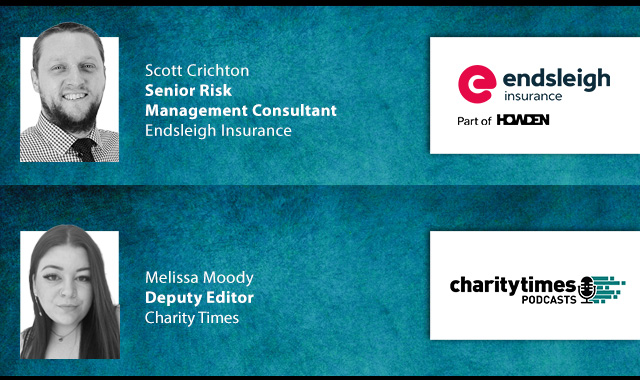
The cost-of-living crisis is impacting charities in a number of ways, including the risks they take. Endsleigh Insurance’s* senior risk management consultant Scott Crichton joins Charity Times to discuss the ramifications of prioritising certain types of risk over others, the financial implications risk can have if not managed properly, and tips for charities to help manage those risks.
* Coming soon… Howden, the new name for Endsleigh.
* Coming soon… Howden, the new name for Endsleigh.
Better Society





© 2021 Perspective Publishing Privacy & Cookies
Recent Stories