Socially responsible investing (SRI) can boost charity investment portfolios, rather than be to their detriment, according to investment managers at Newton Investment, revealed a London roundtable today.
Criticising the view that there is a trade-off between lower investment returns and SRI, Amanda Young SRI officer at Newton said the reverse was true - SRI could produce better returns in the long run.
Young said: "SRI and sustainability are long-term horizons, there are usually five-year time frames and beyond, so rather than seeing negative returns they can be seen as the other way around, with SRI offering better returns on long-term level."
Though Young did qualify her statement by highlighting: "Of course, it does depend on the approach and the investment manager, but the view that SRI offers an inferior return to general investments in not a valid one."
Moreover, Young added that SRI should be seen as separate from a more "negative" Ethical approach. "The consideration of environmental, social and governance (ESG) matters is not about negative screening, nor is it just about risk, but about organisations and what they want from a socially responsible framework."
Though Jason Pidcock, head of the Asian Pacific team at Newton, warned that government intervention posed a problem from an SRI perspective. "During an economic crisis there is a tendency for more government intervention, which can mean more time to deal with officialdom, which can be a challenge on time and resources."


Latest News
-
Charity brands with 'momentum' among the public revealed
-
Regulators issue transparency plea to the public when fundraising
-
Two in three Brits feel ‘overwhelmed by the number of charity appeals’, survey finds
-
Charities retreating into ‘protection mode’ amid online hostility, warns NCVO
-
Regulator considering MP’s claim 32 charities ‘funnelled' £28m to illegal Israeli settlements
-
Code breaches found following investigation into ‘extremely aggressive’ fundraiser





Charity Times video Q&A: In conversation with Hilda Hayo, CEO of Dementia UK
Charity Times editor, Lauren Weymouth, is joined by Dementia UK CEO, Hilda Hayo to discuss why the charity receives such high workplace satisfaction results, what a positive working culture looks like and the importance of lived experience among staff. The pair talk about challenges facing the charity, the impact felt by the pandemic and how it's striving to overcome obstacles and continue to be a highly impactful organisation for anybody affected by dementia.
Charity Times Awards 2023
Mitigating risk and reducing claims
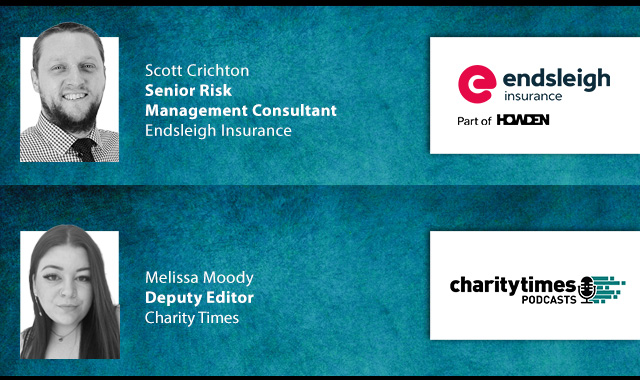
The cost-of-living crisis is impacting charities in a number of ways, including the risks they take. Endsleigh Insurance’s* senior risk management consultant Scott Crichton joins Charity Times to discuss the ramifications of prioritising certain types of risk over others, the financial implications risk can have if not managed properly, and tips for charities to help manage those risks.
* Coming soon… Howden, the new name for Endsleigh.
* Coming soon… Howden, the new name for Endsleigh.
Better Society





© 2021 Perspective Publishing Privacy & Cookies
Recent Stories