Seventy eight per cent of business and NGO professionals participating in an annual survey expect their investment in corporate-NGO partnerships to grow over the next three years.
Significantly, despite slow economic growth and financial austerity, not a single respondent from either sector believed that their investment in partnerships will decrease.
This is one of the key findings in the C&E Corporate-NGO Partnerships Barometer 2011.
The report is based on a survey of corporate responsibility professionals and others from over 150 leading companies and NGOs.
It highlights agreements and disagreements across the sectors.
Reputation and credibility emerge as primary reasons why companies engage in partnerships (scoring 92%, compared with 62% for ‘innovation’ – their second most important reason).
For NGOs, access to funding is the dominant reason for partnering with business.
The survey also discovered a clear shift towards companies and NGOs engaging in more strategic partnerships. 57% of corporate respondents classify over half their partnerships as ‘strategic’ – an increase of 14% over the 2010 equivalent.
The partnership between M&S and Oxfam triumphed again this year, winning the accolade of ‘Most Admired Corporate-NGO Partnership 2011’.
The Barometer discovered some key points of difference between the sectors. For instance:
Companies and NGOs feel very differently about the benefits of non-financial support and how these should be applied. 71% of businesses believe that harnessing their own competencies, brands and non-cash resources would make much more of an impact in helping their NGO partners’ fulfill their mission, than would purely cash-based relationships.
However, only 38% of NGOs agreed with this view
NGOs and businesses feel very differently about corporate employee volunteering, with businesses much more enthusiastic about this method of engaging than are NGOs
Commenting on the report, Manny Amadi, CEO of C&E Advisory, said: “It takes clear leadership on the part of charities to see and seize the full opportunities that partnering with business can bring, whilst navigating its inevitable challenges.
"It is striking that the most admired business-charity partnerships have a clear strategic purpose, often focused on delivering the core mission of both charity and business.
"In our view there is something of a leadership deficit in many charities regarding partnering with companies. Many management teams either don’t ‘get’ the full corporate agenda, or remain focused on driving the narrow, but potential-limiting ‘cash-only’ agenda.
Exploring the role of the public sector in partnerships, the Barometer discovered that:
Many key partnerships involve the public sector. Indeed, only a fifth of respondents indicate that none of their partnerships proactively involve the public sector.
The public sector influences cross-sector partnerships by setting an enabling framework, and by acting as a source of leverage and funding for corporate-NGO partnering
However, the jury is out on the likely influence of the UK coalition government’s Big Society on the corporate-NGO partnering agenda. In what seems a wake-up call to government:
Half the survey respondents see the ‘Big Society’ having only a moderate influence on their corporate-NGO partnering agendas.
Nearly a similar proportion of respondents (44%) said that the Big Society was unlikely to have any influence whatsoever on their cross sector partnering agenda

Latest News
-
Criticism of senior MP’s 'outdated' comparison of charity retail with ‘vape shops’
-
Working Families closes following ‘a sustained period of financial challenge’
-
Case study: How charities can best protect their storytellers
-
British Heart Foundation to close almost one in four of its charity shops
-
Monday movers - 8 June
-
Jobs at risk as RSPB looks to cut operating costs by 7%





Charity Times video Q&A: In conversation with Hilda Hayo, CEO of Dementia UK
Charity Times editor, Lauren Weymouth, is joined by Dementia UK CEO, Hilda Hayo to discuss why the charity receives such high workplace satisfaction results, what a positive working culture looks like and the importance of lived experience among staff. The pair talk about challenges facing the charity, the impact felt by the pandemic and how it's striving to overcome obstacles and continue to be a highly impactful organisation for anybody affected by dementia.
Charity Times Awards 2023
Mitigating risk and reducing claims
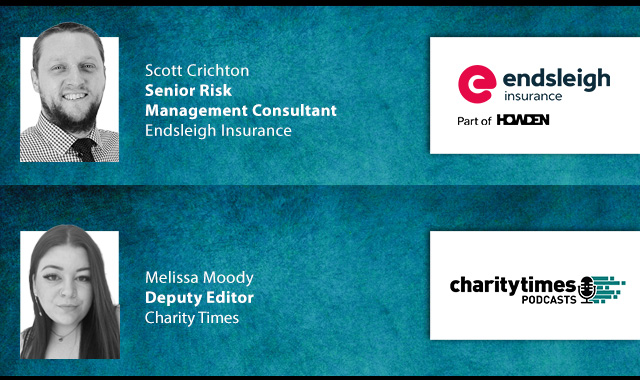
The cost-of-living crisis is impacting charities in a number of ways, including the risks they take. Endsleigh Insurance’s* senior risk management consultant Scott Crichton joins Charity Times to discuss the ramifications of prioritising certain types of risk over others, the financial implications risk can have if not managed properly, and tips for charities to help manage those risks.
* Coming soon… Howden, the new name for Endsleigh.
* Coming soon… Howden, the new name for Endsleigh.
Better Society



© 2021 Perspective Publishing Privacy & Cookies
Recent Stories