The UK’s largest children’s charity Barnardo’s reveals in new data that children are being damaged due to unprecedented delay in the courts in England and Wales.
A five year long pattern of deterioration has led to family courts taking up to 65 weeks to rule if it is safe for children to stay with their parents.
Vulnerable children are waiting on average more than a year (57 weeks) in unstable family homes or emergency foster placements before a county court decides if they will be taken into care. In the family proceedings (magistrates) court the average time is 45 weeks – more than 10 months.
Court data shows that at the end of 2009 there were 50 per cent more unresolved care proceedings cases than at the end of 2008.
According to the The Children and Family Court Advisory and Support Service (Cafcass) in England new applications account for less than half of this increase, indicating that the courts are taking longer to close a significant number of cases.
Martin Narey, Barnardo’s chief executive, said: “An insecurity has spread through the family courts with additional, sequential expert assessments being routinely ordered. This paired with the evident lack of credence given to social workers, is causing unnecessary delay.
“The courts need urgently to reflect on the damage these delays are having on extremely vulnerable children. A year of a child’s life is an inordinate amount of time for them to be trapped in desperate limbo, unclear of their future and very possibly at risk.
“During this time, these children might remain at home with neglectful or abusive birth families or be living in emergency foster care, expected to settle with families they may subsequently have to leave.
“At a time when stable relationships and secure attachments are vital for a child, they are instead engulfed in a period of uncertainty and confusion.”
The data published by Barnardo’s also uncovers a ‘postcode lottery’ governing the fate of children waiting for court decisions throughout England and Wales.
In 2008-09 the county courts in Humber and South Yorkshire took an average of 46 weeks to come to a decision whilst those in London took 65 weeks, close to a staggering five month difference.
Barnardo’s is calling for a radical culture shift in court practice. The Government should give urgent consideration to:
Ensuring all cases are dealt with in less than 30 weeks (seven months) with a tiered, fast track target of 12 weeks for children under 18 months.
Providing family group conferencing to all children and families prior to care proceedings to ensure the early identification of kinship care.
Training for all court staff to improve understanding of the impact of delay on child development.
Establishing liaison forums to improve links between the legal and social work professions to ensure there is greater confidence in social workers’ professional expertise.


Latest News
-
Evaluation reveals benefits of adding a virtual candle to online fundraising
-
Former Scope CEO to chair business group set up to tackle disability exclusion
-
Senior MP’s comparison of charity retail with vape shops criticised as 'outdated'
-
Working Families closes following ‘a sustained period of financial challenge’
-
Case study: How charities can best protect their storytellers
-
British Heart Foundation to close almost one in four of its charity shops





Charity Times video Q&A: In conversation with Hilda Hayo, CEO of Dementia UK
Charity Times editor, Lauren Weymouth, is joined by Dementia UK CEO, Hilda Hayo to discuss why the charity receives such high workplace satisfaction results, what a positive working culture looks like and the importance of lived experience among staff. The pair talk about challenges facing the charity, the impact felt by the pandemic and how it's striving to overcome obstacles and continue to be a highly impactful organisation for anybody affected by dementia.
Charity Times Awards 2023
Mitigating risk and reducing claims
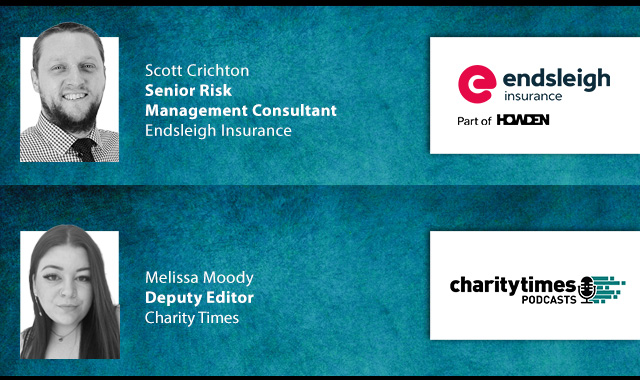
The cost-of-living crisis is impacting charities in a number of ways, including the risks they take. Endsleigh Insurance’s* senior risk management consultant Scott Crichton joins Charity Times to discuss the ramifications of prioritising certain types of risk over others, the financial implications risk can have if not managed properly, and tips for charities to help manage those risks.
* Coming soon… Howden, the new name for Endsleigh.
* Coming soon… Howden, the new name for Endsleigh.
Better Society





© 2021 Perspective Publishing Privacy & Cookies
Recent Stories