A number of sector groups have given their views on the Upper Tribunal’s decision on the issue of charities, public benefit and fee charging.
The Charity Commission says it welcomes the Upper Tribunal’s decision, the NCVO says it is the most significant development in charity law for nearly 50 years, ACEVO says it reinforces the need for all charities to demonstrate public benefit and the Independent Schools Council claimed it as a victory, handing decisions back to school governors.
The case, which went before the Upper Tribunal in May, drew on two sets of proceedings exploring what educational charities charging high fees must do in order to meet the public benefit requirement.
In its ruling, the tribunal confirmed that private schools, as educational charities, have to demonstrate a wider public benefit, beyond that to their own pupils.
And it confirmed that charities have to provide "more than a token benefit" to the poor.
But it concluded that "certain parts of the Charity Commission's guidance were erroneous" and should be rewritten.
The Charity Commission: Tribunal agreed with the Commission's interpretation of the law
The Charity Commission said it was pleased that in its judgement the Tribunal agrees with the Commission's interpretation of the law on the key issues.
The Tribunal’s decision has been widely anticipated and is an important clarification of what charitable independent schools must do for the poor.
The judgement, the Charity Commission said, confirms the regulator’s interpretation of the law in relation to public benefit and independent charitable schools, which has always been that:
A trust which expressly excludes the poor from benefit cannot be a charity.
Charitable independent schools, like any other charity, must in return for the privileges of charitable status operate for the public benefit. This means that they must run their charity to ensure that the poor can benefit in a way that is more than minimal or tokenistic. [paragraphs 178, 215, 222]
Trustees must decide for themselves how their charity provides for the poor, acting fairly in the interests of all beneficiaries and taking into account the circumstances of their charity. The Charity Commission cannot set a specific level or amount of benefit. [paragraphs 217, 220]
The Commission said: "We accept of course the Tribunal’s conclusion that some parts of our guidance do not explain the law clearly enough. We will amend the relevant parts of our public benefit guidance in the light of the Tribunal’s decision, a process we have already begun.
"It is a matter for individual charitable independent schools to decide for themselves how to meet the public benefit requirement as long as it gives more than a tokenistic benefit to the poor.
"The Tribunal has said that there is no clear line which identifies what it is that trustees must do, and acknowledges that it is simply not possible to provide the clarity which we know some schools have wished for. [paragraphs 220-1, 224]
"The public benefit requirement has never been difficult or onerous to meet for charitable independent schools. Charitable independent schools have generally seen the public benefit requirement as an opportunity to highlight the benefits they offer.
The Commission said that charitable independent schools must now make whatever provision for people who can’t afford the fees seems right and appropriate to them, provided it is more than minimal or tokenistic, and they must report on it through their Trustees Annual Report.
The Commission added: "We will amend the relevant parts of our guidance in the light of the Tribunal’s decision, and in the meantime we advise schools that they should look at the Tribunal’s decision. Paragraphs 217-220 in particular set out the Tribunal’s advice to trustees of independent charitable schools. It is our normal practice to consult widely on new or revised guidance.
"It will be a difficult message for some schools to hear that there can be no specific threshold or benchmark which is deemed sufficient to demonstrate public benefit and that they must decide for themselves how they provide the minimum benefit and how they intend to go beyond that to ensure it is more than tokenistic. But the Tribunal is clear on that point."
In paragraph 15, the Tribunal says that its decision is confined to the context of educational charities, and this decision is principally of relevance to them. The Tribunal also notes that its analysis may have wider implications for other charities.
NCVO: Most significant development in charity law for nearly 50 years
This was a ground breaking judgement according Sir Stuart Etherington, chief executive of NCVO, who said: "This case is the most significant development in charity law for nearly 50 years. It reaffirms that public benefit is the cornerstone of charitable law, and sets out how to make this fit for purpose in the 21st century.
"It is positive that the Tribunal have borne in mind NCVO’s argument that the Tribunal's analysis of the principles and accepted that the case law may have wider implications for the charity sector as a whole.
"The Tribunal’s decision has supported NCVO’s view that every case has to be considered individually and that trustees are best placed to decide how best to carry out the purpose for which a charity was established.
"We welcome the Tribunal’s confirmation that educational charities must permit access to their services beyond the narrow range of people who can afford their fees.
"We are also pleased that the Tribunal has agreed with key points in our submission around clarifying how the trustees of educational charities should consider how they can best provide public benefit to the wider community – either directly or indirectly.
"This could include a range of support including the provision of bursaries, arrangements to open up specialist lessons to state school pupils, sharing teachers or teaching facilities.
"This is a landmark decision for the charity sector. By confirming that educational charities have to demonstrate a wider public benefit, the Tribunal has played an important role in maintaining public trust and confidence in the ‘charity brand’.
"We hope that the new guidance that will be produced by the Charity Commission in due course will bring further clarification to the issue of fee charging charities and public benefit."
ACEVO: Reinforces the need for all charities to demonstrate public benefit
Charity Commission, Sir Stephen Bubb, CEO of ACEVO, said: "I am pleased that this decision reinforces the need for all charities - including public schools - to demonstrate how they benefit the public, and for the Charity Commission to challenge them where they do not.
"We now need all charitable private schools to do as much as they can for the communities they operate in, rather than thinking about the minimum required for a tax break. And we need the Charity Commission to have no fear in challenging schools who are not doing enough."
Independent Schools Council: Hands decisions back to school governors
Matthew Burgess, Independent Schools Council general counsel, claimed the decision as a victory.
He said: "The ruling takes public benefit decisions away from the commission and hands them back to school governors, and for that reason we warmly welcome it.
"The ruling liberates schools to innovate and be creative in their charitable provision. The commission' s former approach, now discredited by the tribunal, had the effect of reducing the public benefit of independent schools to a crude calculation of fees and bursaries."
Dickinson Dees: Welcomed by schools
Ros Harwood, head of charities at national law firm, Dickinson Dees, added: "This ruling will very much be welcomed by schools as it places the decision making role back in the hand of the governors.
"It will be a relief to many who had feared that the Charity Commission's guidance would straight jacket them into finding funds to award bursaries up to a pre-determined level, without regard to their individual financial circumstances. Recognising that one size definitely does not fit all will be music to the ears of most governors".

Latest News
-
Nine in ten charities using AI but few exploring its ‘true potential’, warns research
-
Evaluation reveals benefits of adding a virtual candle to online fundraising
-
Former Scope CEO to chair business group set up to tackle disability exclusion
-
Senior MP’s comparison of charity retail with vape shops criticised as 'outdated'
-
Working Families closes following ‘a sustained period of financial challenge’
-
Case study: How charities can best protect their storytellers





Charity Times video Q&A: In conversation with Hilda Hayo, CEO of Dementia UK
Charity Times editor, Lauren Weymouth, is joined by Dementia UK CEO, Hilda Hayo to discuss why the charity receives such high workplace satisfaction results, what a positive working culture looks like and the importance of lived experience among staff. The pair talk about challenges facing the charity, the impact felt by the pandemic and how it's striving to overcome obstacles and continue to be a highly impactful organisation for anybody affected by dementia.
Charity Times Awards 2023
Mitigating risk and reducing claims
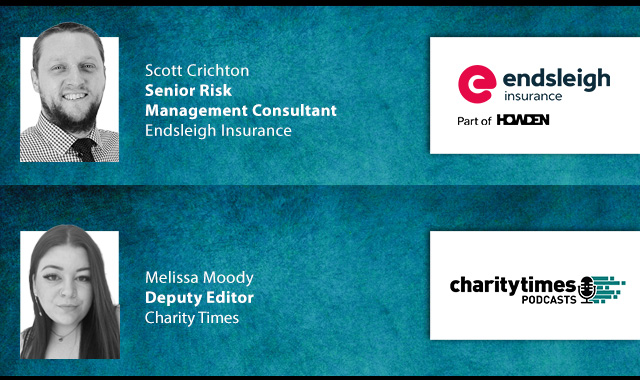
The cost-of-living crisis is impacting charities in a number of ways, including the risks they take. Endsleigh Insurance’s* senior risk management consultant Scott Crichton joins Charity Times to discuss the ramifications of prioritising certain types of risk over others, the financial implications risk can have if not managed properly, and tips for charities to help manage those risks.
* Coming soon… Howden, the new name for Endsleigh.
* Coming soon… Howden, the new name for Endsleigh.
Better Society




© 2021 Perspective Publishing Privacy & Cookies
Recent Stories