Members of the UK200Group of independent accountancy and lawyer firms have commented on the Attorney-General’s request for the High Court to look at whether the Charity Commission is acting illegally by making fee-charging schools offer means-tested bursaries to smaller pupils, or face losing their charitable status.
Ian Selwood, Partner, Randall Payne, said: “There are different levels of independent schools, from those with substantial reserves that would be oversubscribed even at rates that allowed them to give bursaries, to those at the lower end of the scale that are struggling to stay afloat.
"I have no doubt that those at the lower end cannot afford and should not be forced to give bursaries. If they are forced into closure this could increase the burden on the state sector.
“Parents paying for independent schools relieve pressure on the state school system and save all taxpayers money. They have to bear VAT on a substantial element of their costs which state schools do not. The pensions for independent schools are funded by the parents whereas for state schools they are funded by the taxpayers. The list goes on.
“Therefore there are substantial benefits to society to independent schools remaining as charitable institutions even if some exclusivity arises because of fee levels. I would support the Attorney General’s position.”
Anthony Harris, director at Critchleys, added: “The whole matter has been politically motivated by those who appeared envious of the high standards achieved by fee paying schools and were keen to try and water these down by some means or another.
“The suggestion that there is no public benefit from fee paying schools is in itself muddled thinking. Every child that does not go to a state run school – i.e. that goes to a fee-paying school – is subsidising the state system by not making the educational demands on the state!
“It is of course right to review this through the courts as it was a divisive attack on fee paying schools. Creating an attitude of ‘if I can’t have it, I won’t let you’ benefits nobody.”


Latest News
-
Nine in ten charities using AI but few exploring its ‘true potential’, warns research
-
Evaluation reveals benefits of adding a virtual candle to online fundraising
-
Former Scope CEO to chair business group set up to tackle disability exclusion
-
Senior MP’s comparison of charity retail with vape shops criticised as 'outdated'
-
Working Families closes following ‘a sustained period of financial challenge’
-
Case study: How charities can best protect their storytellers





Charity Times video Q&A: In conversation with Hilda Hayo, CEO of Dementia UK
Charity Times editor, Lauren Weymouth, is joined by Dementia UK CEO, Hilda Hayo to discuss why the charity receives such high workplace satisfaction results, what a positive working culture looks like and the importance of lived experience among staff. The pair talk about challenges facing the charity, the impact felt by the pandemic and how it's striving to overcome obstacles and continue to be a highly impactful organisation for anybody affected by dementia.
Charity Times Awards 2023
Mitigating risk and reducing claims
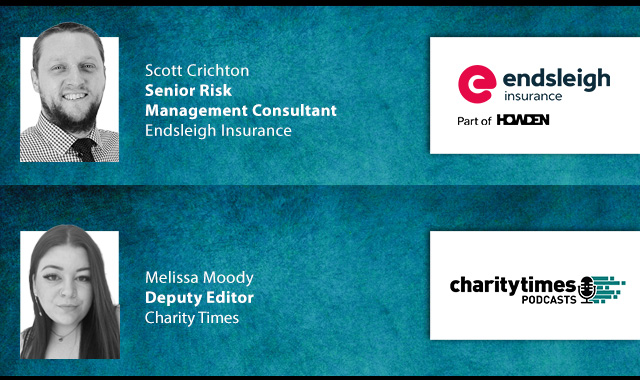
The cost-of-living crisis is impacting charities in a number of ways, including the risks they take. Endsleigh Insurance’s* senior risk management consultant Scott Crichton joins Charity Times to discuss the ramifications of prioritising certain types of risk over others, the financial implications risk can have if not managed properly, and tips for charities to help manage those risks.
* Coming soon… Howden, the new name for Endsleigh.
* Coming soon… Howden, the new name for Endsleigh.
Better Society




© 2021 Perspective Publishing Privacy & Cookies
Recent Stories