The Sector has given its verdicts on the Queen's speech, with a cautiously optimistic mood representing the views.
Responding to the Queen's Speech, Stuart Etherington, chief executive of NCVO, said: "The Government has recognised that the voluntary and community sector must play an important role in realising our shared vision of the good society.
"But our organisations will need to receive the right support and resources, if they are to play their full role in civil society and to deliver high quality, responsive public services.
"Proposals to de-centralise decision making to local authorities and to rebalance the relationship between the citizen and the state are positive. However, to genuinely empower local communities, we need to see a transformation in the relationship between local government and the sector, not just a transfer of powers to local statutory agencies.
"We believe that the right to campaign is essential to a healthy democracy and a vibrant civil society, which is why NCVO's manifesto called for the removal of restrictions on the right to protest peacefully. We are encouraged by early signs on a new approach to civil liberties.
"Fairness must be at heart of the good society. Plans to learn lessons from the financial crisis are necessary in seeking to re-build the UK's economy. NCVO has called for universal access to financial services and for a new approach through the promotion of mutual and co-operative financial models."
Hannah Terrey, head of policy and public affairs at Charities Aid Foundation, said: "We are encouraged by the Queen outlining plans to enhance the role of social enterprises, charities and co-operatives in public services.
"These groups have a wealth of experience of delivering vital services to the most vulnerable. We look forward to seeing the detail and hope that these measures will take forward the Conservative commitment to making it easier for charitable organisations to operate and work with the state.
"This could be further helped by the implementation of the recommendations of Final Report of the Commission on Scottish Devolution will which include the recommendations for single charity registration and common definition across all countries.
"This would significantly ease the bureaucratic burden for charities which operate across the UK. The Government is already making good on some pre-election promises and we hope this will continue."
Commenting on plans to strengthen charities, co-operatives and social enterprises announced by the government in the Queen's Speech, Jonathan Lewis chief executive of The Social Investment Business, said: "We welcome the new government's ambitious plans for growing and strengthening civil society organisations. But deciding on a vision is in many ways the easy part - implementing it will be more challenging.
"We look forward to working closely with ministers to identify where charities, co-operatives and social enterprises can play an even greater role in improving their communities and delivering public services more effectively.
"Increasing the sustainability of civil society organisations so they can both deliver effective local services and benefit from investment in the form of public sector contracts is the key to realising the Big Society.
"But building a stronger civil society can't happen spontaneously. Community groups can only flourish if they can rely on the support and expertise provided by people, like The Social Investment Business, who have a proven track record of helping such organisations become financially viable.
"We already work with civil society organisations to support them empowering local people, managing buildings at the heart of their communities and successfully bidding for contracts in their areas.
"And we led the way in creating 3SC, an innovative consortia of charities and social enterprises, which helps small organisations come together to deliver their excellent services to more people, while at the same time builds the capacity and sustainability of those same community groups. It's clear from today's Queen's Speech that the government is keen to build on the work we have already started."
The King's Fund's director policy, Dr Anna Dixon, added: "The Health Bill and other announcements in the Queen's Speech confirm that the NHS is embarking on a period of significant change.
"Strengthening the role of doctors and the voice of patients will raise some difficult dilemmas. For example, the desire to increase democratic accountability by electing local people to primary care trust boards will be need to be reconciled with the powers of the Secretary of State and statutory bodies to appoint other board members, including the chief executive.
"In setting up an independent NHS board, careful thought will need to be given to the relationship between its responsibilities and those of ministers, who will remain accountable to Parliament for NHS expenditure.
"We welcome the acknowledgement of the critical role played by GPs within the NHS and the clear signal that changes are needed to improve the quality of general practice.
"If, as expected, this includes transferring budgets to GPs, it will be important to learn from the previous experiences of GP-led commissioning in the UK and other countries to ensure it delivers benefits for patients, efficiency savings across the health system while ensuring accountability for public expenditure.
"The emphasis on improving public health and tackling health inequalities, and the priority being given to this by the Secretary of State is heartening. Whether or not the coalition government is able to tackle the economic and social determinants of poor health and reduce health inequalities will be a key test of whether it can work effectively across departmental boundaries - something that eluded its predecessors.
"The prominence given to the commission on long term care is also very positive. Its challenge will be to set out a comprehensive blueprint for reform capable of commanding support across the political spectrum. The government must then map out a clear timetable for implementation, including legislation in the 2011 Queen's Speech."
In response to the Armed Forces bill as outlined in the Queens Speech, Lesley Clark, director of development at Norcare Veterans Centre said: "The Government has outlined that more mental health services are going to be provided for veterans.
"This is an issue which needs to be addressed both in and out of service. There are a number of people who leave the Forces and struggle to adapt to civilian life with mental health issues such as Post Traumatic Stress Disorder being one of the reasons. For the Government to recognise this and provide extra services to help these men and women is very welcome news."
Hetan Shah, the chief executive of the education charity, DEA, welcomed the commitment outlined in the Queen's Speech to spend 0.7 per cent of national income on aid from 2013 to improve the lives of those in the poorest nations.
Shah said: "It is essential though, that government also continues to build support for international development in this country in tough financial times and continues and to champion the humanitarian case for caring for the worst off."


Latest News
-
Nine in ten charities using AI but few exploring its ‘true potential’, warns research
-
Evaluation reveals benefits of adding a virtual candle to online fundraising
-
Former Scope CEO to chair business group set up to tackle disability exclusion
-
Senior MP’s comparison of charity retail with vape shops criticised as 'outdated'
-
Working Families closes following ‘a sustained period of financial challenge’
-
Case study: How charities can best protect their storytellers





Charity Times video Q&A: In conversation with Hilda Hayo, CEO of Dementia UK
Charity Times editor, Lauren Weymouth, is joined by Dementia UK CEO, Hilda Hayo to discuss why the charity receives such high workplace satisfaction results, what a positive working culture looks like and the importance of lived experience among staff. The pair talk about challenges facing the charity, the impact felt by the pandemic and how it's striving to overcome obstacles and continue to be a highly impactful organisation for anybody affected by dementia.
Charity Times Awards 2023
Mitigating risk and reducing claims
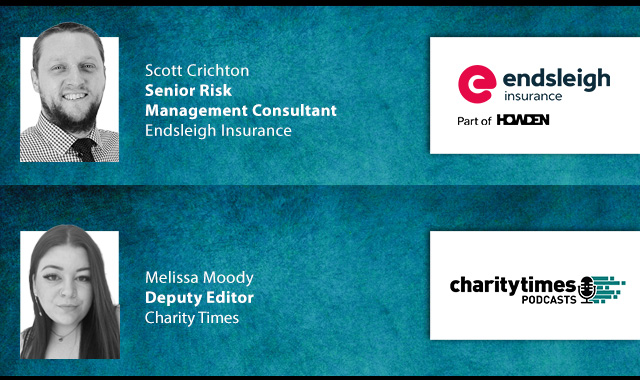
The cost-of-living crisis is impacting charities in a number of ways, including the risks they take. Endsleigh Insurance’s* senior risk management consultant Scott Crichton joins Charity Times to discuss the ramifications of prioritising certain types of risk over others, the financial implications risk can have if not managed properly, and tips for charities to help manage those risks.
* Coming soon… Howden, the new name for Endsleigh.
* Coming soon… Howden, the new name for Endsleigh.
Better Society





© 2021 Perspective Publishing Privacy & Cookies
Recent Stories