Ambitious plans set out by secretary of state for Health Andrew Lansley to reform the NHS during this Parliament and for the long-term, have been broadly welcomed by the sector.
The White Paper Equity and Excellence: Liberating the NHS, details how power will be devolved from Whitehall to patients and professionals.
Professionals will be free to focus on improving health outcomes so that these are amongst the best in the world. Improving the quality of care will become the main purpose of the NHS.
Patients will get more choice and control, backed by an information revolution, so that services are more responsive to patients and designed around them, rather than patients having to fit around services. The principle will be "no decisions about me without me".
Under the new plans, patients will be able to choose which GP practice they register with, regardless of where they live, and choose between consultant-led teams.
More comprehensive and transparent information, such as patients’ own ratings, will help them make these choices together with healthcare professionals.
Groups of GPs will be given freedom and responsibility for commissioning care for their local communities.
Providers of services will have new freedoms and they will be more accountable. There will be greater competition in the NHS and greater cooperation.
Services will be more joined up, supported by a new role for Local Authorities to support integration across health and social care.
As a result of the changes, the NHS will be streamlined with fewer layers of bureaucracy.
Strategic Health Authorities and Primary Care Trusts will be phased out.
Management costs will be reduced so that as much resource as possible supports frontline services.
Responding to the launch of the White Paper on Health, Dr Peter Kyle deputy CEO of ACEVO, said: “The sector will greet today’s return to ‘any willing provider’ with a sense of relief and enthusiasm.
"The major themes of empowering providers, incentivising preventative health interventions, and ambitious plans for social enterprise also give us a real sense of how the government will drive NHS reform forward.
“Both the Department of Health and the third sector must work closely together to ensure that proposals to extend personal budgets, GP commissioning, and ever more personalised services are introduced in a way that harness the strengths and innovation of the third sector.
“Andrew Lansley’s explicit reference to the government’s vision of creating the largest social enterprise sector in the world is precisely the kind of commitment ACEVO has been calling for."
The chief executive of The King’s Fund, professor Chris Ham commented: "The White Paper represents one of the biggest shake ups of the health system since the NHS was established. The ambitions it sets out for a more patient-focused, clinically-led NHS are the right ones. The lesson of the last decade though is that the impact of the reforms will depend critically on how effectively they are implemented.
"Giving GPs responsibility for commissioning care and managing NHS budgets should result in services being more closely aligned with patients’ needs. But, while some GPs will seize this opportunity, many others may be reluctant to come forward and lack the skills needed.
"Setting a deadline for GP consortia to take full financial responsibility for commissioning by 2013 is very ambitious - whether this can be achieved will depend on appropriate support being put in place.
"The White Paper will accelerate the trend towards a mixed economy in the NHS, with foundation trusts freed up to become social enterprises, opportunities for private companies to support GP commissioning and increased opportunities for independent providers to deliver treatment.
"The ensuing debate must focus on delivering the best outcomes for patients, providing the most equitable and efficient care and, importantly, ensuring that data is available to measure these outcomes."
Professor Ham also noted that proposals to strengthen the links between the NHS and local authorities and give councils an enhanced role in improving public health are positive.
"The emphasis on linking health and social care budgets is also welcome. With the NHS facing the most significant financial challenge in its history and substantial cuts to social care budgets likely to follow the Spending Review in the autumn, stronger integration between health and social care services is not just desirable, it is essential."
The White Paper arrives as the NHS faces the biggest financial challenge in its history – the need to find up to £20 billion in productivity savings to maintain quality and avoid cutting services.
Professor Ham added: "The White Paper acknowledges the risks involved in undertaking such wide-ranging reforms. Ministers face a significant challenge in ensuring that effective arrangements are in place to deliver the productivity savings needed and, at the same time, implement the reforms set out in the White Paper.’
Peter Holbrook, CEO of the Social Enterprise Coalition, commented: “The White Paper supports an NHS that is based on more choices for patients, increased focus on outcomes, and greater autonomy for staff and service users - these are principles that social enterprises are wholly committed to.
"SEC welcomes the high level commitment outlined in the White Paper to creating the largest social enterprise sector in the world as well as the proposal for all NHS trusts to become employee-led social enterprises."
However, Holbrook noted there seems to be some confusion in the document as to the differences between Foundation Trusts and social enterprises.
"There needs to be greater understanding of the differences between these two organisational forms and the different roles they can play as part of the landscape for healthcare in England," he said.
The other key reform with implications for social enterprise is the proposed change which will see GPs take charge of commissioning all local services.
Holbrook added: "Placing commissioning under the control of GPs could in theory create a market that encourages more locally tailored, patient focussed social enterprise solutions.
"However, this will require a considerable shift in the capacity of GPs as commissioners – without this there is a considerable danger that the market will be dominated by large providers that will stifle innovation, limit choice and squeeze out smaller, local providers who may be best placed to deliver the improved health outcomes the Government wishes to see."
Health Secretary Andrew Lansley said: "People voted for change and the Coalition Agreement set out a bold and exciting vision for the future of the NHS – a vision based on the principles of freedom, fairness and responsibility.
"The NHS is our priority. That is why the Coalition Government has committed to increases in NHS resources in real terms each year of this Parliament. The sick must not pay for the debt crisis left by the previous administration.
"But the NHS is a priority for reform too. Investment has not been matched by reform. So we will reform the NHS to use those resources far more effectively for the benefit of patients.
"The Government’s ambition is for health outcomes – and quality services – that are among the best in the world. We have in our sights a unique combination of equity and excellence.
"With patients empowered to share in decisions about their care, with professionals free to tailor services around their patients and with a relentless focus on continuously improving results, I am confident that together we can deliver the efficiency and the improvement in quality that is required to make the NHS a truly world class service."
The White Paper is the start of a consultation that will take place over the coming weeks.
The Department of Health will shortly be publishing a number of consultation documents to seek views on more detailed proposals.


Latest News
-
British Heart Foundation to close almost one in four of its charity shops
-
Jobs at risk as RSPB looks to cut operating costs by 7%
-
Monday movers - 8 June
-
‘Lack of buy in’ from charity leaders hindering philanthropy, fundraising body warns
-
World’s wealthiest continue to be less generous than those in lower income countries
-
Seven in ten new regular donors recruited through face-to-face fundraising, survey finds





Charity Times video Q&A: In conversation with Hilda Hayo, CEO of Dementia UK
Charity Times editor, Lauren Weymouth, is joined by Dementia UK CEO, Hilda Hayo to discuss why the charity receives such high workplace satisfaction results, what a positive working culture looks like and the importance of lived experience among staff. The pair talk about challenges facing the charity, the impact felt by the pandemic and how it's striving to overcome obstacles and continue to be a highly impactful organisation for anybody affected by dementia.
Charity Times Awards 2023
Mitigating risk and reducing claims
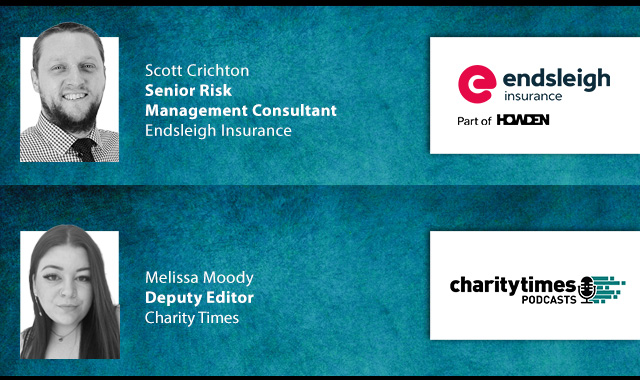
The cost-of-living crisis is impacting charities in a number of ways, including the risks they take. Endsleigh Insurance’s* senior risk management consultant Scott Crichton joins Charity Times to discuss the ramifications of prioritising certain types of risk over others, the financial implications risk can have if not managed properly, and tips for charities to help manage those risks.
* Coming soon… Howden, the new name for Endsleigh.
* Coming soon… Howden, the new name for Endsleigh.
Better Society




© 2021 Perspective Publishing Privacy & Cookies
Recent Stories