NAVCA has today published the results of their annual survey of chief officers, undertaken to find out about the views of CEOs on topical policy issues and the challenges members and local charities face.
Key findings show:
Relationships with statutory bodies are affected by cuts but holding up. Survey results in 2009 and 2010 showed our members’ relationships with local public bodies were improving overall. However, last year chief officers said that relationships had got worse. Results this year indicate some improvement, the number saying their relationship with local authorities has improved increased to 22%, whilst those saying it got worse stood at 23%. For local health bodies, 27% of chief officers said relationships were getting better and 29% they were getting worse.
More certainty on mergers. Around 10% of NAVCA members say they will merge in the coming year, a figure that has been consistent for 4 years. But a big difference is a drop in the number saying they don’t know, down from 43% last year to 14%. This may indicate that uncertainty brought about by major funding cuts in 2011 is subsiding.
A jump in the number of NAVCA members using social media. Over three quarters (78%) of NAVCA members say they are using social media, up from 54% in when the question was asked in 2010.
Competition from national charities is a growing problem for local charities and community groups. In previous years, around a third of chief officers said they know of a local organisation which has lost public funding in competition with a national charity for a services contract. This year this proportion leapt to 56%.
NAVCA members play a vital role in converting national policy into local action. NAVCA members are involved in work supporting all the major new policy initiatives, including Police and Crime Commissioners, social value and asset transfer.
NAVCA members remain a campaigning force. Nearly three quarters (72%) of members are involved in campaigns to save local services.
Commenting on the findings, Joe Irvin, NAVCA’s chief executive, said: “This survey shows why our membership network is vital for translating national policy into local action.
"NAVCA members have a unique reach as they are rooted on the communities they serve. Our 400 members reach160,000 local groups and are involved in all the major initiatives to support local voluntary action.
“I cannot help but think that both national and local government are missing a trick by not using our network more. This survey shows that our members are supporting the initiatives that help local charities.
"But local charities and community groups could receive much more support if government relied more on our network to deliver programmes to support to local charities and community groups.”
This is the fourth year that NAVCA has carried out this survey.

Latest News
-
MSF UK denies knowingly hiring people ‘with ties to terrorism’
-
Regulator restricts housing charity’s transactions amid probe
-
Charity vows to continue tackling homelessness despite day centre closure
-
Charities urge PM to put them ‘at the heart of his plans to rewire the British state’
-
CEO’s departure after only seven months sees charity consider previous candidates
-
Q&A: John Hannaford on balancing immediate needs with long-term impact





Beyond the funding squeeze: Using equities to secure your charity’s future
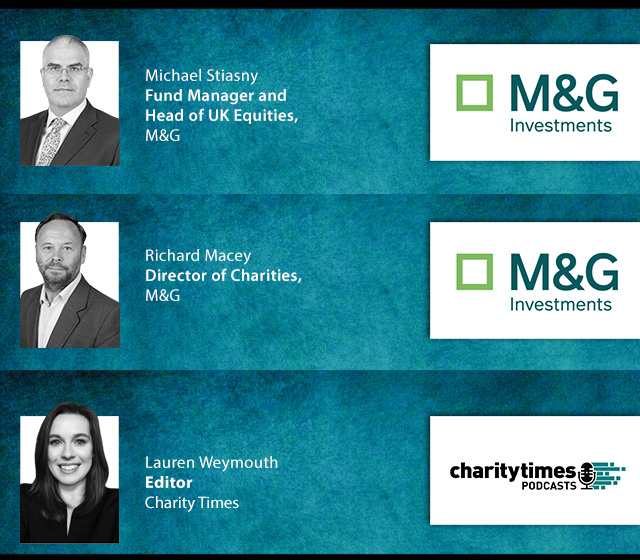
With charities facing increasing financial pressure and traditional income streams under strain, making investments work harder has never been more important. M&G’s Richard Macey and Michael Stiasny join Charity Times to discuss why equities remain a vital long-term asset class for charities, how organisations can balance income generation and growth, and the opportunities the current market environment may offer to help strengthen financial resilience.
Charity Times Awards 2023
Charity Times video Q&A: In conversation with Hilda Hayo, CEO of Dementia UK
Charity Times editor, Lauren Weymouth, is joined by Dementia UK CEO, Hilda Hayo to discuss why the charity receives such high workplace satisfaction results, what a positive working culture looks like and the importance of lived experience among staff. The pair talk about challenges facing the charity, the impact felt by the pandemic and how it's striving to overcome obstacles and continue to be a highly impactful organisation for anybody affected by dementia.




© 2021 Perspective Publishing Privacy & Cookies
Recent Stories