The Directory of Social Change (DSC) has given its assessment of the Green Giving Paper stating it is an important area of work, and supports the aim to increase levels of giving and mutual support in society and to catalyse a culture shift that makes social action a social norm.
Though, the DSC says what it brings to the debate with its assessment is that in the green paper and in the wider discussion to date, there is generally too much emphasis on giving more, and relatively little about how we can give better or give well.
"Nor is there a clear sense of where the generosity is weakest and why – i.e. what sectors or sources of potential philanthropy actually have the most potential for growth – and how efforts could be best focused," states the DSC response.
DSC’s perspective on giving, it notes, is based on a belief that altruism is a valuable social principle in itself, which should be at the heart of all genuinely charitable endeavour.
"Sadly, this ideal seems to be eroded in a consumer society that increasingly views all relationships between people as transactional in some form. It has been further eroded by over a decade of government policy and practice which has viewed the voluntary sector mainly in terms of what it can deliver for the state, as opposed to what its inherent value to society and civic engagement is.
"Part of any Giving agenda should be about restoring the concept of altruism to our collective social consciousness."
It is this issue of the sector's relationship Government which is covered in depth.
The DSC notes: "The rising trend towards commissioning and contractual relationships in recent years has meant that uttering the phrase ‘government gives to charity’ today seems almost heretical. The Giving green paper recognises this role only in brief passages and not in the context of giving money.
"The recent Modernising Commissioning green paper did not mention the word ‘grant’ even once. It appears that grants are viewed as ‘un-modern’ or outmoded, and that anything which remains nominally a grant will in the future not be given in order to help achieve charitable objectives but only if it can ‘demonstrate return on investment’ according to some complicated and largely artificial methodology.
"Still, both government rhetoric and practice in this area remains confused and unclear to charities and the general public. This is in itself problematic."
The DSC adds that much of current government funding behavior clearly involves investing and purchasing but apparently not giving.
"Payment by results contracts look set to be the future vehicle of choice for most public expenditure on ‘external providers’, together with ‘social investment’ provided by the Big Society Bank. Clearly neither qualifies as giving," it warns.
"The exception appears to be relatively small scale local grants programmes such as Communities First, which is a good idea that DSC supports. Local authority grants programmes which ‘give’ to smaller groups are increasingly under threat of being cut or of further drift into ‘purchasing’ or ‘investing’ functions, expressed by funding bureaucracy like excessive and onerous terms and conditions, Key Performance Indicators and Service Level Agreements."
It concludes with five recommendations for both the Government and sector can do to improve giving.
Five things Government could do to improve giving to charity:
1. Ensure more rigorous and transparent reporting of giving by companies;
2. Support a campaign to ‘create a social norm’ that all for-profit companies should donate at least 1% of pretax profits to charity, and feature this as a prominent theme in the Big Society Awards;
3. Resist calls to implement an unworkable and undesirable 5% payout rule for trusts and foundations;
4. Work with the voluntary sector and other institutions like the media to maximise individual giving around major public events;
5. Fundamentally and comprehensively consider its own direct role as a ‘giver’
Five things the voluntary sector / individual charities could do to improve giving
1. Individual trusts and foundations, their representative bodies, and other interested parties should work together to develop ‘good grantmaking’
2. Fundraisers, their representative bodies and trade associations, and other interested parties should improve the quality of fundraisers’ ‘ask’ to funders
3. Fundraising charities, their membership organisations, and self-regulatory bodies should lead a campaign to educate the public about the legitimate costs of fundraising and ‘administration’
4. Leading volunteering organisations should develop a volunteering code of best practice for company staff (or draw together relevant material if it already exists) and promote it to companies
5. Leading volunteering organisations should develop a ‘Chairs of the future’ programme for young trustees, to maintain the supply of future charity trustees
For the full DSC response paper go here


Latest News
-
King’s Birthday Honours List pays tribute to charity leaders and fundraisers
-
Charity brands with 'momentum' among the public revealed
-
Regulators issue transparency plea to the public when fundraising
-
Two in three Brits feel ‘overwhelmed by the number of charity appeals’, survey finds
-
Charities retreating into ‘protection mode’ amid online hostility, warns NCVO
-
Regulator considering MP’s claim 32 charities ‘funnelled' £28m to illegal Israeli settlements





Charity Times video Q&A: In conversation with Hilda Hayo, CEO of Dementia UK
Charity Times editor, Lauren Weymouth, is joined by Dementia UK CEO, Hilda Hayo to discuss why the charity receives such high workplace satisfaction results, what a positive working culture looks like and the importance of lived experience among staff. The pair talk about challenges facing the charity, the impact felt by the pandemic and how it's striving to overcome obstacles and continue to be a highly impactful organisation for anybody affected by dementia.
Charity Times Awards 2023
Mitigating risk and reducing claims
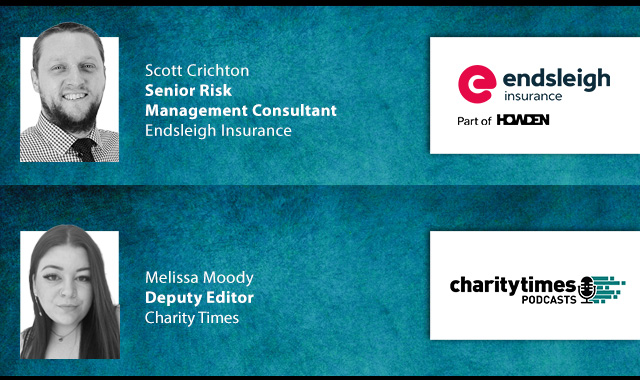
The cost-of-living crisis is impacting charities in a number of ways, including the risks they take. Endsleigh Insurance’s* senior risk management consultant Scott Crichton joins Charity Times to discuss the ramifications of prioritising certain types of risk over others, the financial implications risk can have if not managed properly, and tips for charities to help manage those risks.
* Coming soon… Howden, the new name for Endsleigh.
* Coming soon… Howden, the new name for Endsleigh.
Better Society





© 2021 Perspective Publishing Privacy & Cookies
Recent Stories