A new report has revealed the true cost of financial fraud within the National Health Service.
In collaboration with the think-tank 2020Health, the accountancy firm PKF, and the University of Portsmouth, the report reveals that the total cost of fraud could be as high as £3 billion per year.
The findings are likely to be seized upon by supporters of the government’s NHS reforms, who have long argued that NHS management has to change.
The report’s authors argue that reducing fraud losses is one of the least painful ways to improve efficiency because tackling fraud incurs very little cost when compared with expenses such as procurement, staffing and utilities.
Commenting on the report, Julia Manning, chief executive of 2020Heath, said: “These figures are really quote astonishing. Whether we’re talking about patients abusing the prescription service or hospitals claiming for phantom operations, the total cost of fraud within the NHS is an eye-watering amount.
“Anyone who still claims that the NHS does not need to reform should ask themselves whether £3billion a year is an acceptable price to pay for looking the other way.”
One of the report’s lead authors, Jim Gee, director of Counter Fraud Services at PKF, is a former director of Counter Fraud Services for the Department of Health.
He said: “Fraud can be hugely damaging to any organisation, but especially so to a taxpayer funded body that is responsible for the health of over 60 million people.
“The current official estimate of losses to the NHS - £165 million or around 0.15% of expenditure - would mean that it was 20 times better protected against fraud than any other healthcare organisation internationally.
"This is not credible. Our view is that it would be reasonable to assume that the NHS is no worse or better protected than the best found examples elsewhere, with loses of around 3% of its budget or just over £3 billion per year.
“The NHS has been tasked with finding efficiency savings of £20 billion over the next few years, and so minimising fraud has the potential to improve the quality of healthcare for everyone in this country.”
At present, NHS Trusts are only required to demonstrate that someone is responsible for countering fraud, but they are under no obligation to provide details of how successful they are or to publish information relating to fraud and its costs.
Manning added: “NHS management urgently needs to tackle fraud and to do so in an open way that inspires the confidence of the public.”
The report details examples of common fraud within the NHS, and these include:
Misdirection of resources: one finance manager was found to have placed their entire family on the payroll.
Personal impropriety, such as one CEO who over-claimed on his mileage allowance by 55,000 miles.
Dentists have claimed for fillings which were in fact nickel, and have claimed fees for opening their surgery out of hours, without actually doing this.
Patients lie about their country of origin in widespread abuse of what is known as “health tourism.”
Opticians have been found to claim fees for performing tests on people who were subsequently found to have been dead.
The report notes that healthcare fraud can be carried out by managers, staff, healthcare professionals, patients and contractors.
Manning concluded: “It is never easy to admit that fraud on this scale takes place, but the first step to reducing it is to stop being in denial.”


Latest News
-
Criticism of senior MP’s 'outdated' comparison of charity retail with ‘vape shops’
-
Working Families closes following ‘a sustained period of financial challenge’
-
Case study: How charities can best protect their storytellers
-
British Heart Foundation to close almost one in four of its charity shops
-
Monday movers - 8 June
-
Jobs at risk as RSPB looks to cut operating costs by 7%





Charity Times video Q&A: In conversation with Hilda Hayo, CEO of Dementia UK
Charity Times editor, Lauren Weymouth, is joined by Dementia UK CEO, Hilda Hayo to discuss why the charity receives such high workplace satisfaction results, what a positive working culture looks like and the importance of lived experience among staff. The pair talk about challenges facing the charity, the impact felt by the pandemic and how it's striving to overcome obstacles and continue to be a highly impactful organisation for anybody affected by dementia.
Charity Times Awards 2023
Mitigating risk and reducing claims
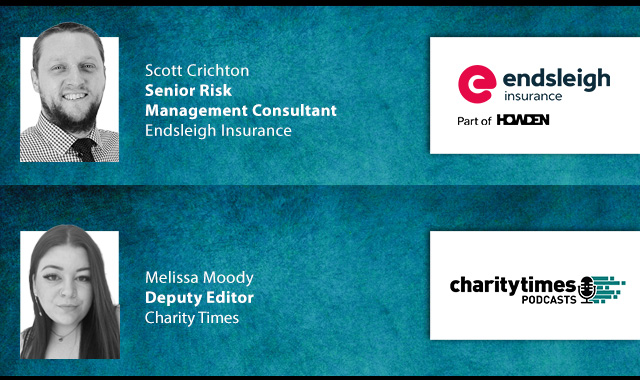
The cost-of-living crisis is impacting charities in a number of ways, including the risks they take. Endsleigh Insurance’s* senior risk management consultant Scott Crichton joins Charity Times to discuss the ramifications of prioritising certain types of risk over others, the financial implications risk can have if not managed properly, and tips for charities to help manage those risks.
* Coming soon… Howden, the new name for Endsleigh.
* Coming soon… Howden, the new name for Endsleigh.
Better Society




© 2021 Perspective Publishing Privacy & Cookies
Recent Stories