New research by the Charity Finance Directors' Group (CFDG), the Institute of Fundraising (IoF) with PricewaterhouseCoopers (PwC) shows charities remain cautious about the future despite the economic upturn.
However, although the majority still expect a fall in overall income in the next 12 months, charities are more positive about the future than they were in May 2009.
The research is the latest in the Managing in a Downturn survey series, undertaken amongst CFDG and IoF members in November 2009.
In the May 2009 survey finance directors were more concerned than fundraising directors in most areas of income.
That picture has now reversed itself completely, with fundraising directors more anxious in all areas except corporate donations.
Going forward, there has been a significant increase in anxiety from the May 2009 survey around Government funding levels, due to widely predicted public funding cuts.
However, charities are not clear when these will occur, although some respondents do not envisage any impact until 2011.
Anxiety around major donors is also high (although lower than the May 2009 survey) with small charities more concerned than their large counterparts.
Small charities are also more concerned about corporate donations than in May 2009.
Charities are also anxious over un-committed public donations, which reflects the competition for public donations in the sector.
The November 2009 survey showed that charities consider investment in fundraising as key to thriving in an upturn.
Some 40% of all respondents are focusing their investment in corporates and 44% on major donors, a clear increase from previous surveys.
In order to maximise the cost-benefit, charities should set milestones of expectation for every fundraising initiative as to the level of "return on investment", which can then be monitored.
Top tips for fundraising investment include:
Better donor care: be flexible and supportive of existing donors
Looking after staff: fundraisers are a valuable asset facing tough times
Monitoring fundraising income: monitor results and challenge under-performance
Exploring different fundraising methods: diversity in income stream is key
Maximising tax-effective giving: make donations work as hard as possible
Clarifying the ask: identify and pursue the most pressing fundraising needs
Making the most of digital media: reach new audiences and communicate more widely
Keep asking: don't ask, don't get
Looking at wages and salaries, some 68% of respondents expect an increase in their wage bill, in comparison with 60% of private companies who have already implemented or will soon implement pay freezes.
This suggests that charities are not being as realistic as the private sector, and are seeing themselves more in line with the public sector.
However, overall, estimates for public sector workforce reduction over the next three years are in the range of 15 to 30%, suggesting that pressure on salaries will follow.
Finally, it is positive to find that charities in the November 2009 survey are continuing to use reserves in order to maintain service delivery.
Charities must, however, use detailed scenario planning in order to avoid reserves becoming a short-term answer that leads to sustainability issues.
Plans for a decreased level of reserves may include collaboration, merger, or scaling back services, but will all take time to implement and decisions need to be taken now to mitigate the challenges of these possible future scenarios.
David Membrey, Acting Chief Executive of the Charity Finance Directors' Group, said: "Decreased anxiety amongst Finance Directors suggests that they have acted swiftly and prudently since November 2008.
"However, it will be necessary to maintain close scrutiny of finances going forward, and to use scenario planning to identify and mitigate the dangers of possible future courses of action. Finance Directors should work closely with their Fundraising colleagues to address the variation in different income streams."
Lindsay Boswell, Chief Executive of the Institute of Fundraising, commented: "Even though we are hearing reports of the end of the recession, for fundraising organisations the effects of the economic downturn are likely to be felt for some time.
"Fundraisers should be heartened that their organisations are doing better than earlier anticipations suggested. However, charities need to keep up their focus on fundraising to ensure that such patterns can continue through 2010."
Ian Oakley-Smith, Director, PricewaterhouseCoopers, added: "This latest survey supports what we are seeing in practice. Many charities are relieved that the impact of the recession has not yet been as significant as might have been feared, but remain concerned about what the future holds.
"Many income streams were committed, often for two or three years ahead, and there is concern that these commitments may not be renewed, either at all or to the same extent. Many funders will be keen that charities demonstrate clearly how they are going to provide a cost-effective delivery."


Latest News
-
Criticism of senior MP’s 'outdated' comparison of charity retail with ‘vape shops’
-
Working Families closes following ‘a sustained period of financial challenge’
-
British Heart Foundation to close almost one in four of its charity shops
-
Monday movers - 8 June
-
Jobs at risk as RSPB looks to cut operating costs by 7%
-
‘Lack of buy in’ from charity leaders hindering philanthropy, fundraising body warns





Charity Times video Q&A: In conversation with Hilda Hayo, CEO of Dementia UK
Charity Times editor, Lauren Weymouth, is joined by Dementia UK CEO, Hilda Hayo to discuss why the charity receives such high workplace satisfaction results, what a positive working culture looks like and the importance of lived experience among staff. The pair talk about challenges facing the charity, the impact felt by the pandemic and how it's striving to overcome obstacles and continue to be a highly impactful organisation for anybody affected by dementia.
Charity Times Awards 2023
Mitigating risk and reducing claims
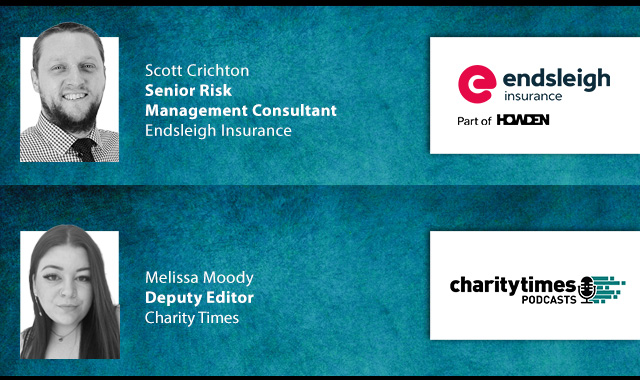
The cost-of-living crisis is impacting charities in a number of ways, including the risks they take. Endsleigh Insurance’s* senior risk management consultant Scott Crichton joins Charity Times to discuss the ramifications of prioritising certain types of risk over others, the financial implications risk can have if not managed properly, and tips for charities to help manage those risks.
* Coming soon… Howden, the new name for Endsleigh.
* Coming soon… Howden, the new name for Endsleigh.
Better Society





© 2021 Perspective Publishing Privacy & Cookies
Recent Stories