Payroll Giving systems need to be fundamentally reformed if they are to generate the high levels of charitable income expected by the Government and desired by charities, say Institute of Fundraising (IoF) members.
Whilst Payroll Giving generates in excess of £114 million a year for good causes, more than 90% of charities questioned by the Institute said they felt systems needed to be fundamentally changed to boost donations.
Louise Richards, director of policy and campaigns at the IoF, said: “Payroll Giving is rightly valued by charities as a way of delivering long-term, planned income in a tax-efficient way but it could provide so much more.
“And it’s not just for big charities – in the US, for example, payroll giving enables employees, and their employers, to give effectively and efficiently to local causes – matching the Government’s localism agenda here.
“Because of the way Payroll Giving is structured, charities face barriers in recruiting new donors and maximising income. Sadly this means that the numbers of Payroll Giving donors have declined steadily since 2008 – for the vast majority of our respondents Payroll Giving now accounts for less than two percent of their income.”
Last year’s Giving White Paper saw the Government calling for significant increases in Payroll Giving by 2015.
But, warns the IoF, this will not happen unless there is real system-wide reform.
“Too many companies refuse to let fundraisers engage directly with their staff and tell them about how they can play a part in helping a cause – and we know that people give to causes, not donation mechanisms,” added Richards.
The Institute of Fundraising is calling on the Government to use three key principles to reform Payroll Giving Systems, increase charity support and boost income:
Universality: greater access for donors to be able to give all people in PAYE the opportunity to make a donation through their payroll. The process for starting a gift should be universal – consistency and transparency would allow a wider variety of promotional mechanisms and clearer messages.
Connectivity: improved contact and relationship between the donor and the charity Donors should be able to contact a charity to set up a payroll gift or respond to an ask directly from the charity (and the donor or the charity should have an efficient way to start the new gift) The charity should receive data about the donor and donations efficiently and effectively to support the relationship and communications with the donor (provided the donor does not opt out of communications) and to monitor the effectiveness of campaigns they are investing in.
Portability: maintain the donation as circumstances change Donations should automatically continue from payroll when the donor changes
employers There should be an opportunity to continue donations into retirement on taxed pension schemes (eventually also including state pensions).


Latest News
-
British Heart Foundation to close almost one in four of its charity shops
-
Jobs at risk as RSPB looks to cut operating costs by 7%
-
Monday movers - 8 June
-
‘Lack of buy in’ from charity leaders hindering philanthropy, fundraising body warns
-
World’s wealthiest continue to be less generous than those in lower income countries
-
Seven in ten new regular donors recruited through face-to-face fundraising, survey finds





Charity Times video Q&A: In conversation with Hilda Hayo, CEO of Dementia UK
Charity Times editor, Lauren Weymouth, is joined by Dementia UK CEO, Hilda Hayo to discuss why the charity receives such high workplace satisfaction results, what a positive working culture looks like and the importance of lived experience among staff. The pair talk about challenges facing the charity, the impact felt by the pandemic and how it's striving to overcome obstacles and continue to be a highly impactful organisation for anybody affected by dementia.
Charity Times Awards 2023
Mitigating risk and reducing claims
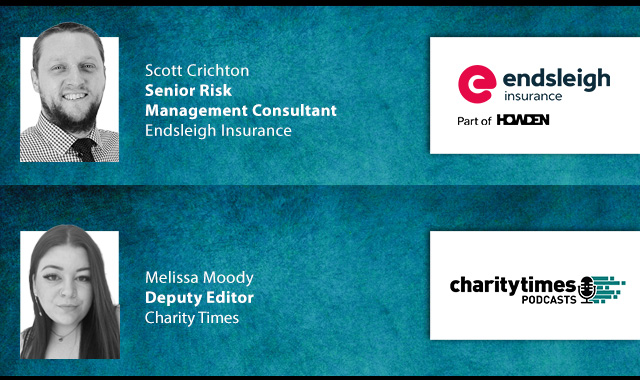
The cost-of-living crisis is impacting charities in a number of ways, including the risks they take. Endsleigh Insurance’s* senior risk management consultant Scott Crichton joins Charity Times to discuss the ramifications of prioritising certain types of risk over others, the financial implications risk can have if not managed properly, and tips for charities to help manage those risks.
* Coming soon… Howden, the new name for Endsleigh.
* Coming soon… Howden, the new name for Endsleigh.
Better Society





© 2021 Perspective Publishing Privacy & Cookies
Recent Stories