Responding to Government research carried out amongst higher-rate taxpayers about possible changes to Gift Aid John Low, chief executive of the Charities Aid Foundation has put his case for Gift Aid.
He said: "Gift Aid provides a vital source of income for UK charities worth around £900m each year but as the Government and charities recognise it needs to be reformed so that we stop losing £750m per year.
"Under the current system there is too much paperwork and the rules and systems are too complex. We ourselves have a whole warehouse full of declarations. Surely there must be a better way?"
He said he wanted changes to simplify the process for both charities and donors. "To be long-term and sustainable, anticipating any future changes that could affect the amount of Gift Aid that is claimable and the implications for donors such as income tax rates and rules.
"It is also vital that Gift Aid is preserved as a tax relief rather than morphed into discretionary Government spending that could change year on year and dependent on the political priority of the day. And finally any new system needs to be heavily promoted by Government and charities because unprompted only one in three adults can name Gift Aid as a way of donating tax-effectively.
"We accept that there isn't an easy fix for the problems with Gift Aid. Of the two options for reform researched by the Government, the composite rate looks like the best outcome for charities and would potentially be a fairer system treating all donors equally, but success will depend upon how well change is implemented. I do however have a number of concerns about this route.
"A higher charity reclaim rate should encourage more people to tick the Gift Aid box, especially basic rate tax payers who will see significant added value to their donation. But as this research shows, the money that higher-rate taxpayers can currently claim back is an incentive for some of them to give, and this research doesn't tell us how much money might not be given if the ability to personally reclaim higher rate tax on donations is withdrawn."
He also noted this research has not investigated the behaviour and attitudes of ultra high net worth individuals who together make billions of pounds of charitable donations every year.
"If the composite rate were static, in the long run the sector would be worse off if the basic rate of income tax subsequently decreased. We would therefore prefer any composite rate to be floating, set at a percentage above basic income tax.
"A composite rate could add another layer of complexity if the system works in the same way as the current transitional relief, with charities having to claim money separately from different 'pots'.
"As the research shows there would be winners and losers in the sector. Those organisations who have traditionally had strong support from higher-rate tax payers may find that their income decreases as these donors adjust their donation levels.
"We welcome the research and the evidence based policy development it implies and we look forward to taking part in discussions with Government and other charities about the best way forward."
The research is available on the HMRC website: http://www.hm-treasury.gov.uk/d/gift_aid_reseach_report_091208.pdf


Latest News
-
British Heart Foundation to close almost one in four of its charity shops
-
Jobs at risk as RSPB looks to cut operating costs by 7%
-
Monday movers - 8 June
-
‘Lack of buy in’ from charity leaders hindering philanthropy, fundraising body warns
-
World’s wealthiest continue to be less generous than those in lower income countries
-
Seven in ten new regular donors recruited through face-to-face fundraising, survey finds





Charity Times video Q&A: In conversation with Hilda Hayo, CEO of Dementia UK
Charity Times editor, Lauren Weymouth, is joined by Dementia UK CEO, Hilda Hayo to discuss why the charity receives such high workplace satisfaction results, what a positive working culture looks like and the importance of lived experience among staff. The pair talk about challenges facing the charity, the impact felt by the pandemic and how it's striving to overcome obstacles and continue to be a highly impactful organisation for anybody affected by dementia.
Charity Times Awards 2023
Mitigating risk and reducing claims
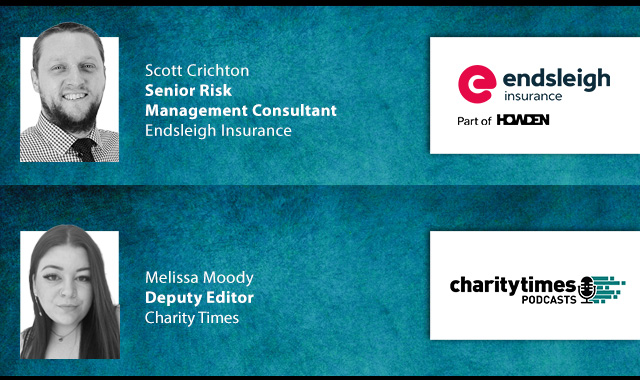
The cost-of-living crisis is impacting charities in a number of ways, including the risks they take. Endsleigh Insurance’s* senior risk management consultant Scott Crichton joins Charity Times to discuss the ramifications of prioritising certain types of risk over others, the financial implications risk can have if not managed properly, and tips for charities to help manage those risks.
* Coming soon… Howden, the new name for Endsleigh.
* Coming soon… Howden, the new name for Endsleigh.
Better Society




© 2021 Perspective Publishing Privacy & Cookies
Recent Stories