Despite severe austerity measures and cuts to public services, more than six out of 10 people still think that it is morally right for the UK to help developing countries.
New survey results published today by the Institute of Development Studies, a global charity, reveals that 62% of people think it is our obligation as human beings to help the world’s poor people.
Nonetheless, the majority of respondents (64 %) think that poverty at home is the priority.
Despite the fact that government aid only accounted for £80 per person in 2009 (compared with £1,801 per person on pensions, and £1,808 per person on health care) 63 per cent think aid needs to be cut to help deal with the budget deficit. Over half (57 per cent) of respondents did not support the coalition government’s policy of ring-fencing aid spending.
The results are published today in Aid to Developing Countries: Where does the UK Public Stand?, the first report of the UK Public Opinion Monitor (UKPOM).
The report’s recommendations include that the development sector should take a new approach to communicating with the public about how and when aid works, thus addressing the view expressed by over half of all respondents that most aid is wasted.
The UKPOM, managed by the Institute of Development Studies, is a representative panel of people from across the UK.
The report presents a summary of results from surveys undertaken over the period June to August 2010.
This is the first time that a long-term panel of the general public will be used to explore attitudes towards development over time in the UK.
The report also uncovers the drivers behind people’s attitudes on aid spending, including:
· Aid wastage – 52 per cent of respondents thought that most UK aid to developing countries is wasted. Holding this view increased the likelihood of supporting cuts in aid spending by 15 per cent.
· Age - Older people are 21 per cent more likely to propose reducing the aid budget than younger people. This was one of the most important factors.
· Political standpoint - Conservative voters are 12 per cent more likely to support cutting the aid budget than Labour voters. Liberal Democrat voters are no more likely to support cuts than Labour voters.
Professor Lawrence Haddad, director of the Institute of Development Studies, said:
“It is encouraging that, even in times of austerity, the majority of people say we have a moral obligation to help the poor in the world.
"The concerning finding from our survey is that many respondents believe aid is wasted. Yet IDS research has consistently demonstrated that aid really does make an enormous difference to poor people.
"This survey suggests development charities and the Government need to take a fresh approach to engaging with the public about aid. We need to hear more from the people whose lives have been changed by aid. We should do more to understand what UK taxpayers need to hear to be convinced that aid works. And we need to be honest about what works and what doesn’t, so we can learn for the future.”
Research using the UKPOM is ongoing, with future topics to include whether aid should be linked to UK security and trade, and the international response to the earthquake in Pakistan.


Latest News
-
Criticism of senior MP’s 'outdated' comparison of charity retail with ‘vape shops’
-
Working Families closes following ‘a sustained period of financial challenge’
-
British Heart Foundation to close almost one in four of its charity shops
-
Monday movers - 8 June
-
Jobs at risk as RSPB looks to cut operating costs by 7%
-
‘Lack of buy in’ from charity leaders hindering philanthropy, fundraising body warns





Charity Times video Q&A: In conversation with Hilda Hayo, CEO of Dementia UK
Charity Times editor, Lauren Weymouth, is joined by Dementia UK CEO, Hilda Hayo to discuss why the charity receives such high workplace satisfaction results, what a positive working culture looks like and the importance of lived experience among staff. The pair talk about challenges facing the charity, the impact felt by the pandemic and how it's striving to overcome obstacles and continue to be a highly impactful organisation for anybody affected by dementia.
Charity Times Awards 2023
Mitigating risk and reducing claims
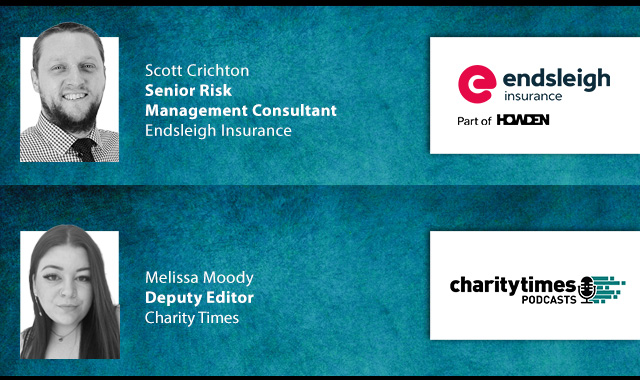
The cost-of-living crisis is impacting charities in a number of ways, including the risks they take. Endsleigh Insurance’s* senior risk management consultant Scott Crichton joins Charity Times to discuss the ramifications of prioritising certain types of risk over others, the financial implications risk can have if not managed properly, and tips for charities to help manage those risks.
* Coming soon… Howden, the new name for Endsleigh.
* Coming soon… Howden, the new name for Endsleigh.
Better Society




© 2021 Perspective Publishing Privacy & Cookies
Recent Stories