The Directory of Social Change (DSC) convened another of its discussions between the minister for Civil Society Nick Hurd, and charity leaders, which highlighted discontentment amongst some charities, and the approach of the government on matters relating to the sector.
The idea behind the meeting was to connect charities directly with a leading decision-maker, providing an uncensored opportunity to influence which might otherwise not be available to them.
There was an open format to the meeting with Hurd outlining the government’s ambition to encourage more social action, make it easier for charities to do their work, and to get more resources into the voluntary sector.
The participants then raised the issues they thought were important, often discussing with each other as the minister listened.
The main themes covered problems with commissioning and procurement, and conflicts with the localism agenda.
Jay Kennedy, head of policy at the Directory of Social Change, said: "Many participants expressed familiar frustrations at the way services were being commissioned locally, as well as bewilderment that the valued principles of localism seemed so often in conflict with the actual practice of commissioning.
"The Work Programme, the Government’s re-employment programme, was described as complex, bureaucratic, top-down, inefficient, and not delivering for service users.
"It is felt to be structured in such a way that it squeezes out the participation of small local charities, who are already ‘lean and mean’ and may have been delivering effective services for decades."
Hurd said he was aware of the issues but that it was a new programme and a work in progress, and that he was in ‘daily contact’ with Employment minister Chris Grayling about it.
He said it was important to keep in mind too that the primary purpose is to get unemployed people back into work.
There was also much discussion about the sheer cost of procurement bureaucracy, with the required documentation measured by the bundle.
"Some participants described the considerable direct cash costs of tendering – in the thousands of pounds – plus the lost opportunity costs of failed bids or just needing to spend time and resources to evaluate opportunities," said Kennedy.
"Delegates repeatedly questioned the waste inherent in current processes and stressed that it negatively affected their work, drawing their energy away from where it should be – focusing on delivering the highest quality service.
"Many people argued that local voluntary groups needed more grant funding, especially for core costs. This needed to be targeted at small organisations, and managed by local funders such as Community Foundations who had good knowledge of local groups."
Nick Hurd in turn, recognised these concerns and related his experience of Government’s actions to cut massive waste in how it procures equipment and other supplies.
Kennedy noted: "Hurd fully agreed that the system had to be made more efficient; things like payment by results and outcomes commissioning were designed to bring greater efficiency eventually, but the Government faced a hugely difficult task to change the current commissioning culture, and it would take time.
"However, many participants argued that payment by results was just another barrier to commissioning small local groups, because they could not take the risk or afford the financial outlay to deliver a service on the basis that payment might only be made well into the future."
The business case
Many participants welcomed the possibility of more joint-working with business, but there was disagreement about the potential and nature of such relationships.
Some people felt that taking advantage of the opportunities required a change of mindset from charities – to be able and willing to speak the language of business, and approach them accordingly.
Others felt that business often treated their organisations poorly, patronised charities, and did not want to give what the charities needed – and that changing their language or approach would mean drifting away from their own values or ethics.
A number of delegates pointed out that more businesses needed to consider what charities needed when deciding what to give.
Kennedy added: "There were very good reasons that charities commonly asked for cash, not time or in-kind support from business. Charities needed long-term committed volunteers – not people to come in and paint the building on a Saturday.
"Nick Hurd said he saw more potential for in-kind giving and partnership arrangements, because many businesses were struggling and did not have spare cash."
There was consensus that communication – understanding what charities needed from business, and what business was prepared to give – needed to be radically improved if the relationships were to be more productive.
In responding to these comments Hurd said that the Business Connector scheme was designed in part to help bridge the gap, and that he could see many signs from leading businesses of a more engaged, constructive approach.
Marginalised communities: the paradox
A number of participants questioned the government’s commitment to equalities, and argued that the way it was making cuts and commissioning services was putting already vulnerable people under even greater threat.
However, the point was also made that even in deprived or marginalised communities, there were often huge amounts of generosity and giving already.
"This paradox was at the heart of a ‘message problem’ for the Government," observed Kennedy.
Several participants also argued that a major problem with the Government’s ‘message’ on giving was that it was seen as morally compromised.
"There is a certain level of resentment in many communities; a feeling that collective social responsibilities are simply being dumped on those individual citizens who care," said Kennedy.
The argument was made that the government, or politics and politicians in general, are perceived as being more about ‘the culture of greed’ than ‘the culture of giving’.
"The implication being that inspiring change in the wider society would require a genuine culture change in the political system, and more leading by example from politicians and other leaders," said Kennedy.
In responding to these points, Hurd said that he understood the frustration caused by differences between rhetoric and reality, but that in order to achieve change you have to provide leadership, and that part of this was providing a vision.
The Big Society was, he said, a ten or twenty year project.
For those disadvantaged and marginalised communities, his hope was that greater local decision-making, including things like community budgeting, would empower them – but that the government was very much resistant to trying to direct things further from the centre as they see that as part of the problem.
Delegates at the DSC event were:
Nick Hurd MP, minister for Civil Society
Amira Asantewa, operations manager, Youth at Risk
Annette Fleming, chief executive Officer, Aquarius
Gerry LeJeune OBE, chief executive, Berkshire East & South Bucks Women's Aid
Ross Walker & Carrie Starace, co-directors, Teachsport
John Barrett, service manager, Small Charities Coalition
Ged Simpson, funding advisor, Liverpool Charity and Voluntary Services | United Way
Beverley Costa, chief executive officer, Mothertongue
Liza Dresner, director, Resources for Autism
Philippe Granger, development manager, Rushey Green Time Bank
Peter Day, development officer, Churches Housing Action Team (CHAT)
Lewis Herlitz, development officer, Employment & Training Consortium
D’Arcy Myers, chief executive officer, The Rainbow Centre
Victoria Warne, deputy director, Capital Community Foundation
Jess Wood, project director, All Sorts Youth Project
Lysa Schwartz, chief executive officer, the Makaton Charity


Latest News
-
Criticism of senior MP’s 'outdated' comparison of charity retail with ‘vape shops’
-
Working Families closes following ‘a sustained period of financial challenge’
-
Case study: How charities can best protect their storytellers
-
British Heart Foundation to close almost one in four of its charity shops
-
Monday movers - 8 June
-
Jobs at risk as RSPB looks to cut operating costs by 7%





Charity Times video Q&A: In conversation with Hilda Hayo, CEO of Dementia UK
Charity Times editor, Lauren Weymouth, is joined by Dementia UK CEO, Hilda Hayo to discuss why the charity receives such high workplace satisfaction results, what a positive working culture looks like and the importance of lived experience among staff. The pair talk about challenges facing the charity, the impact felt by the pandemic and how it's striving to overcome obstacles and continue to be a highly impactful organisation for anybody affected by dementia.
Charity Times Awards 2023
Mitigating risk and reducing claims
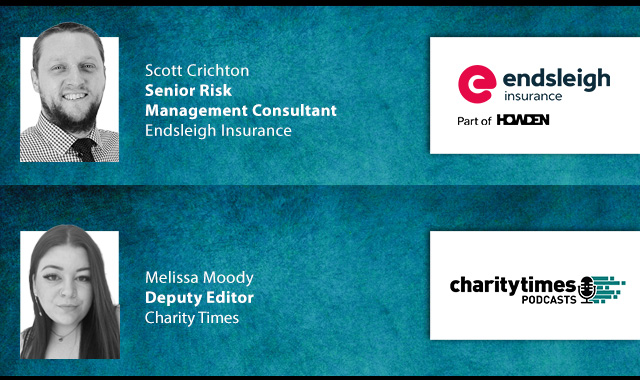
The cost-of-living crisis is impacting charities in a number of ways, including the risks they take. Endsleigh Insurance’s* senior risk management consultant Scott Crichton joins Charity Times to discuss the ramifications of prioritising certain types of risk over others, the financial implications risk can have if not managed properly, and tips for charities to help manage those risks.
* Coming soon… Howden, the new name for Endsleigh.
* Coming soon… Howden, the new name for Endsleigh.
Better Society




© 2021 Perspective Publishing Privacy & Cookies
Recent Stories