Michael Gove, the Secretary of State for Education, has proclaimed the Big Society success of the Government's academies programme, announcing another milestone as the number of academies in England reaches 1,500.
Academies are a key element of building a school system in which teachers have more power and in which they are more accountable to parents - not politicians.
Though they have faced opposition from the Labour Party and many trade unions.
Attacking this criticism Gove said: "The same ideologues who are happy with failure - the enemies of promise - also say you can't get the same results in the inner cities as the leafy suburbs so it's wrong to stigmatise these schools.
"Let's be clear what these people mean. Let's hold their prejudices up to the light. What are they saying?
"If you're poor, if you're Turkish, if you're Somali, then we don't expect you to succeed. You will always be second class and it's no surprise your schools are second class.
"I utterly reject that attitude. It's the bigoted backward bankrupt ideology of a left wing establishment that perpetuates division and denies opportunity. And it's an ideology that's been proven wrong time and time again."
Gove said there are 1,529 Academies open in England; 1,194 are converters and 335 are sponsored.
45% of all maintained secondary schools are either open or in the pipeline to become Academies.
There are 37 local authority areas where over half of secondary schools are already Academies, and 64 LAs where more than half of secondaries are either open Academies or in the process of becoming Academies.
Over 90% in North East Lincolnshire; over 88% in Bromley; over 82% in Swindon; over 80% in Thurrock.
Three in five outstanding secondaries - and nearly 1 in 10 outstanding primaries - has applied to convert to an Academy.
Over 1,250,000 pupils now attend Academies.
This means around one in seven pupils in state schools now attends an Academy - one in three pupils in state secondaries.
In an average week, the Department for Education processes 20 applications from schools to convert to Academy status, brokers another five schools to become sponsored Academies.
Setting out the case for academies, Gove cited a three part argument: "An academy conversion generates a significant improvement in pupil performance. Second, that - contrary to what the critics claimed was happening - this improvement is not the result of Academies scooping up middle-class pupils from nearby schools.
"While it's true that, increasingly, more middle-class parents want to send their children to the local Academy, this phenomenon is a consequence of the school's success, not the cause.
"And thirdly, beyond raising standards for their own pupils, academies also tend to raise pupil performance in neighbouring schools. Success is contagious."


Latest News
-
Criticism of senior MP’s 'outdated' comparison of charity retail with ‘vape shops’
-
Working Families closes following ‘a sustained period of financial challenge’
-
Case study: How charities can best protect their storytellers
-
British Heart Foundation to close almost one in four of its charity shops
-
Monday movers - 8 June
-
Jobs at risk as RSPB looks to cut operating costs by 7%





Charity Times video Q&A: In conversation with Hilda Hayo, CEO of Dementia UK
Charity Times editor, Lauren Weymouth, is joined by Dementia UK CEO, Hilda Hayo to discuss why the charity receives such high workplace satisfaction results, what a positive working culture looks like and the importance of lived experience among staff. The pair talk about challenges facing the charity, the impact felt by the pandemic and how it's striving to overcome obstacles and continue to be a highly impactful organisation for anybody affected by dementia.
Charity Times Awards 2023
Mitigating risk and reducing claims
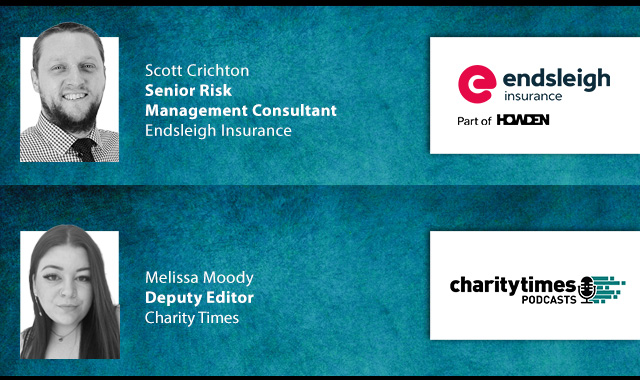
The cost-of-living crisis is impacting charities in a number of ways, including the risks they take. Endsleigh Insurance’s* senior risk management consultant Scott Crichton joins Charity Times to discuss the ramifications of prioritising certain types of risk over others, the financial implications risk can have if not managed properly, and tips for charities to help manage those risks.
* Coming soon… Howden, the new name for Endsleigh.
* Coming soon… Howden, the new name for Endsleigh.
Better Society





© 2021 Perspective Publishing Privacy & Cookies
Recent Stories